
PU Gasket Dispensing Machine: An Introduction to Automated Sealing Technology for Enclosures
A PU gasket dispensing machine is an automated system that meters, mixes and dispenses two-component polyurethane (PU) directly onto a part, forming a sealing gasket in place rather than installing a pre-moulded one. In enclosure manufacturing, its job can be stated in one sentence: it provides dust-proof and explosion-proof sealing for enclosures, and it is designed to operate inside an automatic gluing production line in 24/7 continuous mode.
That definition matters because enclosure sealing is not a finishing detail. On an electrical control panel, a distribution board, an explosion-proof box or a lighting housing, the gasket decides whether the finished product meets its ingress protection and explosion-proof requirements. Automated dispensing is what makes that outcome repeatable at production volume.
This introduction covers what the technology does, the production conditions it is built for — including a working temperature range of −20 to 40 °C and common requirements such as explosion-proof construction and IP66 waterproofing — the industries that use it, and how a specific configuration is assembled. KAIWEI's model KW-510B is used throughout as a concrete example.
Why Enclosure Sealing Becomes a Production Problem
Enclosures leak where two surfaces meet. The gap between a housing body and its cover is the shortest path for dust, moisture and — in hazardous locations — for an internal ignition source to reach a flammable atmosphere. The gasket that closes that gap is therefore a functional component, not a cosmetic one.
Manual sealing makes that outcome harder to control. Hand-applied gaskets depend on operator consistency, can shift or over-compress during assembly, and add a separate step to the line. Pre-cut or moulded gaskets solve the consistency question but introduce inventory, splicing and joints, and they only fit the shape they were cut for. A dispensed PU gasket removes both problems: the gasket is generated on the part, in the geometry the part requires, by the machine that is already part of the production line.
Three production realities push manufacturers toward automated dispensing:
- Certified sealing outcomes. Enclosure applications commonly specify IP66 waterproofing and explosion-proof construction, and the sealing process directly affects whether those requirements are met.
- Volume and rhythm. Enclosure production is frequently organised as 24/7 continuous operation on an automatic production line, where a manual sealing step becomes the bottleneck.
- Environment. The specified working condition for these applications is a temperature range of −20 to 40 °C, with the machine required to hold dispensing accuracy across that range.
The problem, in short, is not whether a gasket can be applied — it is whether the same gasket quality can be repeated on every unit, every shift, for years.
Industry Background: Where PU Gasket Dispensing Sits in 2026
The equipment belongs to a market that has been expanding steadily rather than in a single spike. According to Market Research Future, the broader polyurethane processing machine market was valued at USD 6.627 billion in 2024 and is projected to grow at a CAGR of 10.21% through 2035. Within that, a narrower estimate from Kaiwei Industry Analysis places the global market for polyurethane gasket dispensing machines at approximately USD 1.2 billion in 2025.
The demand driver closest to enclosure manufacturing is form-in-place sealing. Maximize Market Research reported that the form-in-place (FIP) liquid gaskets market reached USD 270 million in 2023, with increasing adoption in EV battery enclosures — a product category that shares the same sealing logic as electrical control panels: a housing, a cover, and a requirement that nothing gets in.
Supply is concentrated. Grand View Research recorded that Asia-Pacific dominated the polyurethane processing machine market with a 42.2% share, driven by industrial manufacturing growth in China. Verified competitor landscape data for the FIPFG and PU dispensing equipment sector lists Sonderhoff (Henkel), RAMPF Group, Cera-Tec and Kaiwei among the suppliers active in this space.
On market figures: published projections for this equipment differ substantially depending on scope. Estimates for the specific PU gasket machine category and for broader PU processing machinery are not directly comparable, and buyers should treat any single number as scope-dependent rather than absolute.
Regulation shapes the technical baseline as much as demand does. PU foaming machines must comply with the EU Machinery Directive 2006/42/EC and EN 60204-1 for electrical safety in order to obtain CE marking — a requirement that applies regardless of where the machine is built, if the finished product is placed on the European market.
What a PU Gasket Dispensing Machine Does
Core function: dust-proof and explosion-proof sealing
The primary function of the equipment is to provide dust-proof and explosion-proof sealing for enclosures. Both functions are produced by the same dispensed bead, which is why the machine appears in product categories as different as electrical control panels and explosion-proof electrical housings.
Operationally, the system is built for automatic production line operation and 24/7 continuous operation. It must be used with an automatic gluing production line — it is not designed as a standalone manual bench tool. The declared working condition is a temperature range of −20 to 40 °C, and the applications it serves typically carry special requirements for explosion-proof construction and IP66 waterproofing.
KAIWEI is a Shanghai-based manufacturer founded in 2004 that develops industrial sealing systems, robot foaming equipment and intelligent sealing and dispensing equipment. The company states that its products are CE and ISO9001 certified and that its dispensing equipment is used in electric cabinets, air filters, air conditioning purification equipment, lamps, automobiles and new energy fields.
How the system is built
A PU gasket dispensing machine is a small process plant rather than a single tool. The main subsystems are:
- Material supply. Two air-pressure tanks (typically A: 40 L, B: 40 L) hold the polyurethane components. Tank A is agitated; tank B is not. Filling can be manual or automatic, and an automatic filling station is an option.
- Metering. Metering pumps (KAIWEI or Barmag, with specifications such as A3cc/r and B0.6cc/r) control the mix ratio, which is adjustable across a 1–10:1 range.
- Mixing head. The mixing head (for example KW-900 or KW800) combines the components and lays the bead. It is cleaned with high-pressure water, which is why a tap water supply is part of the utility list.
- Motion. A linear robot arm moves the head along the gasket path. Running speed and effective stroke determine cycle time and the maximum part size the machine can cover.
- Control. A touch-screen HMI plus handheld controller or teach pendant drives the system; the controller is either a motion control card or a teach pendant combined with a PLC.
- Temperature and utilities. Water temperature control is available as an option. Power supply is 220 V / 380 V at 4 kW / 5.5 kW, and air pressure requirement is ≥ 6 bar with an oil-water separator on the air source.
KAIWEI's technical documentation for the system states 30% higher mixing uniformity than alternatives, which matters because mix quality determines whether the bead cures to a consistent gasket or develops soft spots that fail sealing later.
Configuration example: KAIWEI KW-510B
The KW-510B is one concrete configuration within KAIWEI's PU gasket dispensing machine range. Its published specifications are:
- Raw material: polyurethane; component selection: two-component / three-component
- Mixing head model: KW-900; seal strip width: 4–30 mm; mixing ratio: 1–10:1
- Metering pump: KAIWEI / Barmag, A3cc/r and B0.6cc/r
- Raw material tanks: A 40 L, B 40 L air pressure tanks; tank A agitation; manual or automatic filling
- Temperature control: water temperature control (optional)
- Frame structure: 3-axis linear robot arm; running speed: 0–12000 mm/min
- Effective stroke: 2250 × 1250 × 200; workbench: square tube welding; dimension: 2000 × 1000 × 800
- HMI: touch screen, 12.1 inches; interface mode: cantilever control box; handheld controller / teach pendant
- Controller: motion control card / teach pendant + PLC
- Power supply: 220 V / 380 V; power: 4 kW / 5.5 kW; air pressure requirement: ≥ 6 bar
- Cleaning: high-pressure water; water tank with front level sensor and outlet filtration
- Guide rail: KAIWEI / AIRTAC; rack: Rsun; servo motor: Xinje; reducer: Senad
- Materials of construction: carbon steel / stainless steel 304 / aluminium alloy
Step-by-Step: Specifying and Running an Enclosure Sealing Project
Moving from a sealing requirement to a running production line follows a predictable sequence. Each step also acts as a decision point where the wrong choice shows up later as a failed seal or a stalled line.
- Define the enclosure's sealing specification. Establish the function (dust-proof, explosion-proof, or both), the target IP rating — IP66 is common in these applications — the part geometry, the production volume and the shop-floor temperature. The application baseline is −20 to 40 °C, so confirm whether your environment sits inside that window.
- Select the machine configuration. Choose between two-component and three-component material systems, and set the seal strip width. Widths such as 4–30 mm suit general enclosure work, while 2–10 mm and 10–60 mm ranges fit finer or wider gasket profiles. A three-axis linear robot arm covers flat enclosure faces; a six-axis arm is used where the gasket path is not planar.
- Set up the material supply and metering. Confirm tank configuration (A 40 L / B 40 L is standard), decide between manual and automatic filling, and specify whether an automatic filling station and water temperature control are needed. Fix the mix ratio within the 1–10:1 range that the metering pumps support.
- Integrate with the automatic gluing production line. The machine must be used with an automatic gluing production line, so position it where the conveyor, part positioning and line signalling reach it. Confirm the utilities: 220 V / 380 V power at 4 kW / 5.5 kW, air at ≥ 6 bar with an oil-water separator, and tap water for mixing head cleaning.
- Program and validate the gasket path. Gasket geometry is programmed through the touch-screen HMI, the handheld controller or teach pendant, or a PC. Run a validation batch to confirm bead placement, corner behaviour on complex shapes and cycle time before committing the line to full output.
- Run production with verification built in. Once validated, the system operates in 24/7 continuous mode within the automatic production line. KAIWEI states that quality control is 100% test, meaning machines are fully tested before shipment rather than sampled.
- Plan customization, service and continuity. Confirm what can be customized for your project, and plan support. KAIWEI offers OEM/ODM production, a minimum order quantity of 1 set, a stated lead time of 7 days, and after-sales support delivered remotely.
Use Cases: Enclosure Industries That Run PU Gasket Dispensing
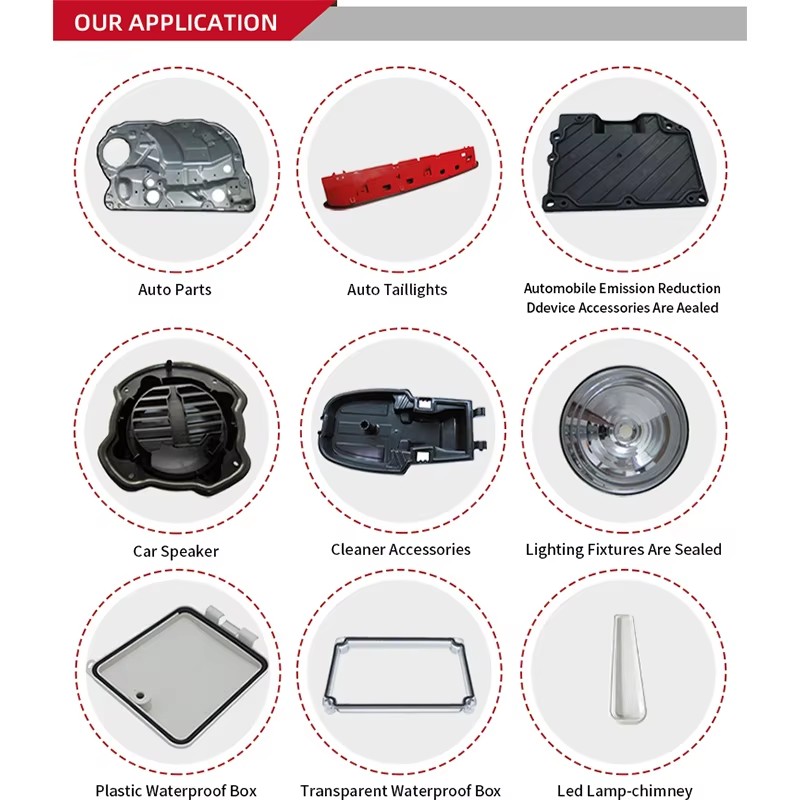
The same sealing function is applied across a broad set of enclosure categories. The technology is described as suitable for high-precision sealing and mass production scenarios, including electrical control panels, distribution boards and automotive parts.
- Electrical control panels and distribution boards. The most direct application: automatic sealing of panel enclosures with dust-proof and explosion-proof requirements, on an automatic gluing production line, under the −20 to 40 °C working condition.
- Explosion-proof electrical and special electrical equipment. Housings where the sealing function is part of the safety case, and where explosion-proof construction and IP66 waterproofing are typically specified.
- Lighting and LED luminaires. Outdoor lights, street lighting, stadium lighting and explosion-proof light housings, where the gasket protects against moisture and dust ingress.
- Home appliances. Refrigerator doors, appliance cabinets and similar housings produced at high volume.
- Purification, environmental protection and filtration equipment. Air cleaning filters and purification room door components.
- Lock and hardware accessories. Lock shells and related hardware enclosures.
- Automotive parts. Battery covers, inner door handles, mountings and enclosures produced on mass-production lines.
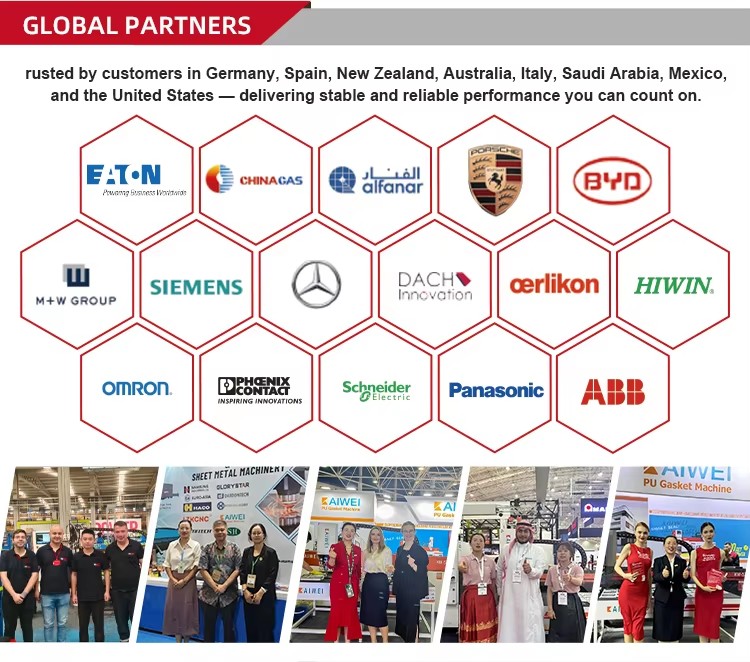
A documented deployment illustrates the pattern: an automotive OEM in the United States installed 20 units for a paint shop application. After 2 years of service, the reported results were stable operation, IP66 waterproof and dust-proof sealing, and high production efficiency, supported by high-precision dispensing, automatic production and customized gasket shapes.
Comparison: Matching Enclosure Requirements to Machine Configurations
The fastest way to check project fit is to compare the enclosure requirement against what the equipment is specified to deliver.
| Enclosure project requirement | What it means on the line | How the PU gasket dispensing machine addresses it |
|---|---|---|
| Dust and moisture protection | IP66 waterproofing and dust-proof sealing are commonly specified | Provides dust-proof sealing for enclosures through a dispensed polyurethane gasket |
| Hazardous-area service | Explosion-proof construction is a declared special requirement | Provides explosion-proof sealing for enclosures within the same dispensing process |
| Production rhythm | 24/7 continuous operation on an automatic production line | Operates in 24/7 continuous mode and must be used with an automatic gluing production line |
| Shop-floor environment | Stable operation at −20 to 40 °C | Working condition specified for the application is −20 to 40 °C |
| Precision and volume | High-precision sealing and mass production | Designed for high-precision sealing and mass production in electrical control panels, distribution boards and automotive parts |
Model selection then narrows to the physical configuration. Four models from the same range illustrate how the choice changes with the part:
| Model | Frame structure | Seal strip width | HMI screen | Interface mode |
|---|---|---|---|---|
| KW-510B | 3-axis linear robot arm | 4–30 mm | 12.1 inches | Cantilever control box |
| KW-520B | 3-axis linear robot arm | 4–30 mm | 15 inches | Integrated operation box |
| KW-523A | 3-axis linear robot arm | 2–10 mm / 10–60 mm | 15 inches | Integrated operation box |
| KW-526 | 6-axis linear robot arm | 2–60 mm | 15 inches | Integrated operation box |
Across the range, raw material is polyurethane (the KW-523 and KW-523A also accept silicone), mixing ratio is adjustable within 1–10:1, metering pumps are KAIWEI or Barmag, material tanks are A 40 L / B 40 L air pressure tanks, and power supply is 220 V / 380 V at 4 kW / 5.5 kW. The differences that matter for project fit are gasket width, arm configuration and the control interface.
FAQ
Which standards and sealing ratings apply to a PU gasket dispensing machine for enclosure projects?
The machine's primary function is to provide dust-proof and explosion-proof sealing for enclosures, and enclosure applications typically carry special requirements for explosion-proof construction and IP66 waterproofing. On the compliance side, PU foaming machines must comply with the EU Machinery Directive 2006/42/EC and EN 60204-1 for electrical safety in order to obtain CE marking. KAIWEI states that its products have passed international certifications including CE and ISO9001.
Can one machine handle both dust-proof and explosion-proof enclosure sealing?
Yes. The declared function of the product is to provide dust-proof and explosion-proof sealing for enclosures — both properties come from the same dispensed polyurethane gasket. The system is used in electrical control panels, explosion-proof electrical and special electrical equipment, lighting, home appliances, purification and filtration equipment, lock and hardware accessories, and automotive parts, and it operates in 24/7 continuous mode within a −20 to 40 °C environment.
What has to be in place before the machine can run?
It must be used with an automatic gluing production line; the equipment is not designed as a standalone manual sealing tool. On utilities, the KW-510B configuration requires a 220 V / 380 V power supply at 4 kW / 5.5 kW, compressed air at ≥ 6 bar with an oil-water separator on the air source, and a tap water supply for high-pressure water cleaning of the mixing head. Part positioning and line integration are handled at the project stage, with control through a touch-screen HMI, handheld controller or teach pendant, or a PC.
How can a buyer validate the machine before committing to full-scale production?
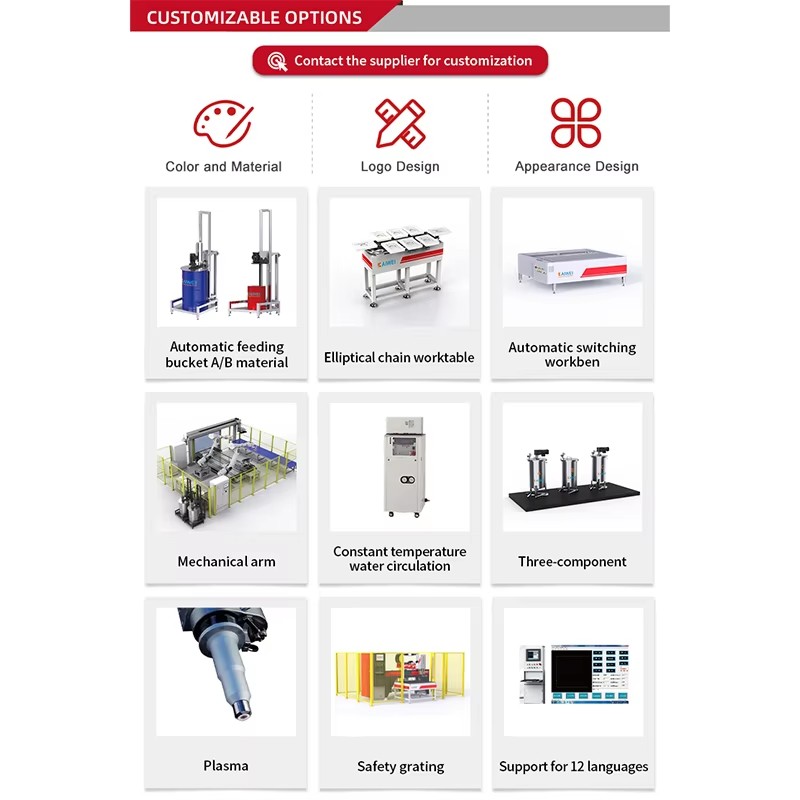
Validation starts with configuration rather than volume. The minimum order quantity is 1 set, so a project can begin with a single machine, and KAIWEI applies 100% test quality control, meaning machines are tested before shipment rather than sampled. Gasket geometry is programmed through the HMI or teach pendant, which allows a validation batch to confirm bead placement and corner behaviour on the actual enclosure before the line runs at full output. OEM/ODM customization is available and covers items such as color and material, automatic A/B material feeding, mechanical arm configuration, plasma treatment, logo and appearance design, elliptical chain worktable, constant temperature water circulation, safety grating, automatic switching workbench, three-component systems and support for 12 languages.
What lead time and after-sales support should be planned for?
KAIWEI states a lead time of 7 days and a minimum order quantity of 1 set, with after-sales support delivered remotely. Because the machine must run inside an automatic gluing production line, the practical planning window also includes line integration, utility preparation and the validation batch, not just machine delivery. To review a configuration for your enclosure project, request a quotation or the product catalogue at info@kaiwei-sh.com, or download the KAIWEI product brochure for full model specifications.
Conclusion
A PU gasket dispensing machine solves a specific and recurring problem in enclosure manufacturing: how to produce a certified, dust-proof and explosion-proof seal on every unit, at production volume, without adding a manual bottleneck to the line. The technology meters and mixes two-component polyurethane, dispenses it as a form-in-place gasket, and runs inside an automatic gluing production line in 24/7 continuous operation across a −20 to 40 °C working range.
Its fit is determined by the project, not by the catalogue. Electrical control panels, explosion-proof housings, LED luminaires, home appliance enclosures, filtration equipment and automotive parts all use the same sealing principle but differ in gasket width, part geometry, control interface and utility setup — which is why configuration selection (component count, seal strip width, robot arm axis, worktable and interface) matters as much as the machine category itself.
KAIWEI has manufactured sealing and dispensing equipment from Shanghai since 2004, states CE and ISO9001 certification for its products, and exports to more than 60 countries. For buyers in the research and evaluation stage, the practical next step is to define the enclosure's sealing specification and map it against a concrete configuration before committing a production line.
Next Step: Specify Your Enclosure Sealing Project
Send your enclosure type, target IP rating, gasket width and production volume, and KAIWEI will respond with a matching PU gasket dispensing machine configuration, indicating mixing head, robot arm structure, seal strip width and control interface.
Website: www.sh-kaiwei.com | Email: info@kaiwei-sh.com | WhatsApp: +86 13761986986 | Brochure: Download the KAIWEI product catalogue
Have Questions or Need More Details?
Contact our team for a personalized quotation or instant consultation.
Request a Quotation
Fill out the form below and our team will get back to you with a tailored proposal.
WhatsApp Direct Chat
Prefer to chat in real-time? Message us on WhatsApp for instant assistance & quick answers.
- Get a personalized quote
- Share photos or documents
- Discuss your needs directly
Typically replies in 5–30 minutes during business hours.