
PU Gasket Dispensing Machine Sector Ranking: Where Automatic Sealing Delivers the Strongest Fit
A PU gasket dispensing machine is a form-in-place sealing system: it dispenses a metered polyurethane bead onto a part, and that bead cures in place as the finished gasket. The technology is the same in every industry, but the fit is not. This ranking orders seven industrial sectors by how strongly their part geometry, sealing requirement and production rhythm match what an automatic dispensing platform can repeat reliably on a 24/7 line. The order is an editorial fit assessment built from recorded application attributes and published KAIWEI machine specifications — not a market-size ranking.
The Short Answer: Which Sectors Fit a PU Gasket Dispensing Machine Best
Ranked from strongest to weakest operational fit for automatic PU sealing:
- Electrical Control Panels — large flat cabinet doors and panels inside a standard three-axis envelope; KAIWEI lists the KW-510B for electrical control panels, and the enclosure sealing requirement is protection-critical.
- Explosion-proof Electrical & Special Electrical — the same flat-panel geometry family as control panels, but with the highest consequence attached to a failed gasket, so process control and documentation carry more weight than machine size.
- Lighting & LED Lighting — long, mostly linear gasket paths on lamp covers and luminaire housings; high product mix in length rather than in shape.
- Auto Parts & Components — proven in service (a US automotive OEM running 20 units for two years), but many parts need a six-axis platform because the gasket path leaves a single plane.
- Home Appliances — large flat panels and doors with high volume; KAIWEI lists the KW-510B for domestic appliances, and fit depends heavily on fixture and changeover design.
- Purification, Environmental Protection & Filtration Equipment — air filter frames and filtration housings are often narrow-flanged and open, which shifts effort from the dispensing head to the fixture.
- Lock & Hardware Accessories — small parts with narrow beads; technically straightforward on a compact three-axis machine, but the per-part economics demand very high volume.
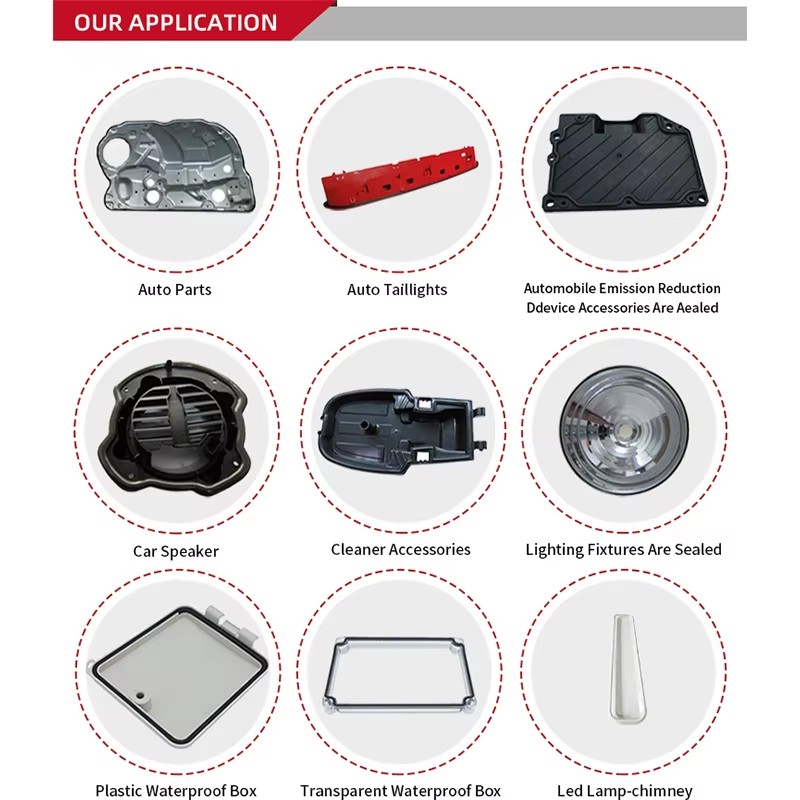
Application fields recorded for automatic PU sealing: electrical enclosures, lighting, automotive components, appliances and filtration equipment. Image: KAIWEI application field reference.
Problem Definition: Why Sector Fit, Not Machine Size, Decides the Outcome
The failure mode of an automated sealing project is rarely the dispenser itself. It is a mismatch between the machine and the part: a gasket path that the robot cannot reach without re-orienting the work, a flange too narrow for the bead to sit on, or a cycle that cannot absorb the programming and cleaning steps between two different products. Buyers who compare only stroke length, axis count or mixing-head model tend to discover this mismatch after the machine is installed.
A useful way to think about fit is to separate the sector-level requirement from the part-level requirement. At sector level, the seven application units used in this ranking share one identical recorded profile. Every one of them specifies automatic sealing as the project type, dust-proof sealing and explosion-proof sealing for enclosures as the function, 24/7 continuous operation on an automatic production line, an automatic gluing production line as the matched equipment, and explosion-proof and IP66 waterproof protection as the special requirement. They are also all recorded for the same −20 °C to 40 °C working condition.
Because that profile is common to all seven, it cannot be used to rank them. What separates the sectors is the part: a control-cabinet door that is flat and generously flanged is a fundamentally easier target than a lock shell with a narrow bead, even though both must meet the same sealing specification. That is why the ranking below is built on part geometry, bead width, sealing criticality and line behaviour — the four variables a buyer can actually check against a machine specification.
Industry Background: Where Polyurethane Dispensing Equipment Stands in 2026
The equipment sits inside a broad polyurethane processing machinery market valued at USD 4.07 billion in 2025, according to published commercial research. The narrower automatic polyurethane foaming machine segment is reported at USD 606 million in 2025 with a projected USD 832 million by 2032. These figures describe the machinery tier, not the sealing result, and they are useful mainly as a directional indicator that automatic forming is an established industrial process rather than an emerging experiment.
Shanghai Kaiwei Intelligent Technology (Group) Co., Ltd., trading as KAIWEI, is a Shanghai-based manufacturer of industrial sealing systems and robot foaming equipment, founded in 2004. The company operates a production site exceeding 20,000 m², reports more than 30 engineers in its core technical team, holds CE certification MD-TCF-240307-55472 under Machinery Directive 2006/42/EC for the EU market, and states ISO9001 certification. KAIWEI reports an annual output of 2000 units and an export ratio of around 70%, with equipment supplied to markets including Germany, the United States, Southeast Asia, the Middle East, Africa and South America. Those facts matter in a sector ranking because they describe a supplier that has already had to answer the same sealing questions across many of the industries listed here.
The practical consequence for buyers is that the market now offers a range of standardised platforms instead of only bespoke systems. That makes the selection question sharper: the task is no longer whether automation is possible, but which platform and which configuration reproduce the required gasket across a specific product family.
Detailed Solution: The Machine Platform Behind Every Sector Fit
All KAIWEI PU gasket dispensing machines share a common architecture, with the differences concentrated in motion frame, working envelope and bead-width capability. Understanding those three layers is enough to place any of the seven sectors on the right platform.
Material delivery and mixing
The machines run two-component or three-component polyurethane, with a mixing ratio range of 1–10:1. Material is drawn from two 40 L air-pressure tanks; tank A supports agitation while tank B does not. Metering pumps are KAIWEI or Barmag units with A3cc/r and B0.6cc/r specifications, and the mixing head is either the KW800 or the KW900, the latter being a pump-type head designed for parameter adjustment through the control system and simplified maintenance. Filling and air charging can be manual or automatic, an external filling station is optional, and cleaning is performed with high-pressure water. Optional water temperature control is available through a constant-temperature circulation configuration. For dust-proof and explosion-proof sealing work, this layer is where bead consistency is won or lost: a stable ratio and a clean head are what keep the gasket section uniform around the full path.
Motion, stroke and bead width
Two motion families exist. The three-axis linear robot arm appears in the KW-510B, KW-520A, KW-520B, 520A-PC, KW-523 and KW-523A, with effective strokes of 2250 × 1250 × 200 mm on the large-format models and 1250 × 800 × 200 mm on the compact models. The six-axis linear robot arm appears in the KW-526, which combines a customized effective stroke with a 2–60 mm seal-strip range for complex and multi-plane sealing tasks. Where a gasket path stays on one plane, the three-axis family is the simpler answer; where the path wraps around a corner, a flange step or a curved housing, the six-axis arm removes the need to reposition the part mid-cycle. Programmed travel speed on the large three-axis models and the KW-526 reaches up to 12,000 mm/min, which is what allows a long lighting or cabinet-door path to stay inside a short cycle.
Control and line integration
Control is built on a motion control card, or a teach pendant combined with a PLC, operated through a PC or a handheld teach pendant. Screen size varies by model: 15 inches on the KW-520B, KW-526, KW-523 and KW-523A; 12.1 inches on the KW-510B; 10.2 inches on the KW-520A and 520A-PC. Interface housings are either an integrated operation box or a cantilever control box mounted beside the work area. Workbench structures are square-tube welded, and the machines accept 220 V or 380 V supply at 4 kW or 5.5 kW, with an air pressure requirement of at least 6 bar and an oil-water separator in the air treatment path. Water supply is standard tap water with a front level sensor and outlet filtration. These details decide how easily a machine slots into an existing automatic gluing production line with 24/7 operation.
Model-to-envelope reference
| Model | Robot frame | Effective stroke | Seal strip width | Mixing head | HMI |
|---|---|---|---|---|---|
| KW-510B | 3-axis linear | 2250 × 1250 × 200 mm | 4–30 mm | KW-900 | 12.1 in, cantilever control box |
| KW-520A | 3-axis linear | 2250 × 1250 × 200 mm | 4–30 mm | KW800 | 10.2 in, integrated operation box |
| KW-520B | 3-axis linear | 2250 × 1250 × 200 mm | 4–30 mm | KW-900 | 15 in, integrated operation box |
| 520A-PC | 3-axis linear | 2250 × 1250 × 200 mm | 4–30 mm | KW800 | 10.2 in, teach pendant control |
| KW-523 / KW-523A | 3-axis linear | 1250 × 800 × 200 mm | 2–10 mm or 10–60 mm | KW800 / KW-900 | 15 in, integrated operation box |
| KW-526 | 6-axis linear | Customized | 2–60 mm | KW800 / KW-900 | 15 in, integrated operation box |
Specifications as published by KAIWEI. All models run two-component or three-component polyurethane at a 1–10:1 mixing ratio with dual 40 L tanks and high-pressure water cleaning.
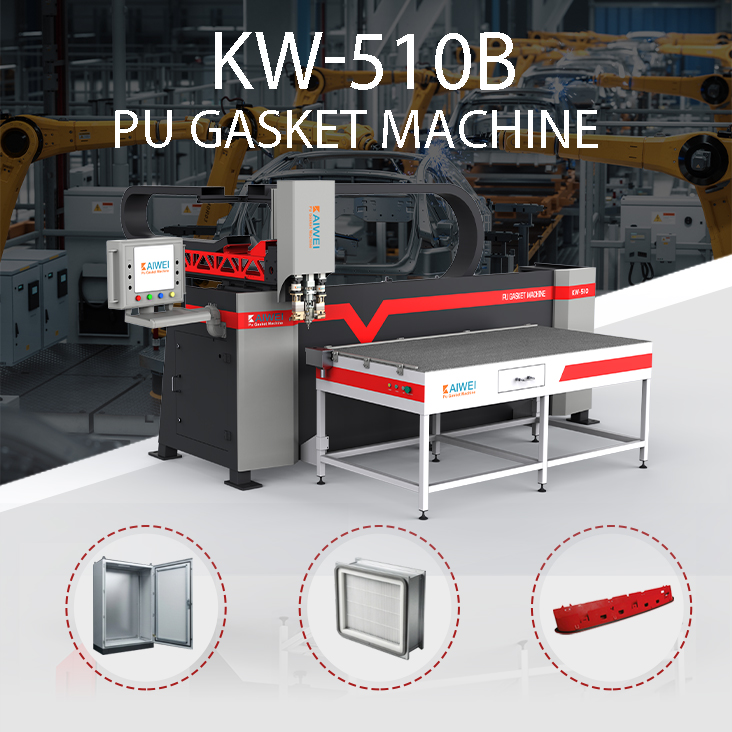
KW-510B: three-axis linear robot arm, 2250 × 1250 × 200 mm effective stroke, 4–30 mm seal strip, KW-900 mixing head — the platform KAIWEI lists for electrical control panels, air filters and domestic appliances.
The Ranking: Seven Sectors Ordered by Fit Strength
1. Electrical Control Panels — highest fit
Electrical control panels are the strongest fit because the part geometry is the least troublesome the technology will ever see: flat rectangular doors and panels with a continuous flange, sized comfortably inside the 2250 × 1250 × 200 mm envelope of the KW-510B, and matched to a 4–30 mm bead that covers typical enclosure gasket sections. KAIWEI lists the KW-510B explicitly for electrical control panels. The sealing requirement is genuinely protection-critical — dust-proof sealing, explosion-proof sealing for enclosures and IP66 waterproof performance — so the value of a repeatable formed-in-place gasket is high, while the programming effort is low. With programmed travel speed up to 12,000 mm/min, a full door perimeter can be completed quickly enough to keep pace with a 24/7 automatic gluing production line. The remaining engineering work is fixturing: door flatness and clamping repeatability determine whether the bead stays centred on the flange.
2. Explosion-proof Electrical & Special Electrical
This sector ranks second because the consequence of a gasket defect is the highest of the seven. Anti-explosion boxes and explosion-proof shells appear directly in KAIWEI's recorded application list, and the same flat-panel or flanged-box geometry that makes control panels easy also applies here. What changes is the tolerance for variation: the gasket is part of the enclosure protection concept, so ratio stability, head cleaning and bead continuity matter more than raw throughput. This is where the platform details earn their place — metering pumps holding a 1–10:1 ratio, high-pressure water cleaning between shots to avoid partially cured material contaminating the next bead, and optional water temperature control to keep material behaviour stable across a shift. Fit is very strong in geometry terms, but qualification effort is higher, and buyers should expect to spend more time on process documentation than on path programming.
3. Lighting & LED Lighting
Lamp covers, street lighting, stadium lighting, brake lights, LED luminaires and explosion-proof lights share a common trait: the gasket path is long and predominantly linear. That makes lighting a strong three-axis application, and the 4–30 mm strip range on the KW-510B or KW-520A covers most housing gasket profiles. The complication is product mix rather than shape — a luminaire family often contains many lengths and widths that must run on one machine, so programming library management and fixture changeover become the limiting factors. Where a housing curves or the gasket turns onto a side wall, the six-axis KW-526 and its 2–60 mm strip range become the better answer. The dust-proof and IP66 waterproof requirement on outdoor luminaires is exactly the type of protection duty a continuous, formed-in-place bead serves well.
4. Auto Parts & Components
Auto parts rank fourth despite having the most direct service evidence in the record. A US automotive OEM has been running 20 units in a paint shop application for two years, reporting stable operation, IP66 waterproof and dust-proof sealing, high production efficiency, high-precision dispensing and a customized gasket shape under automatic production. The reason the sector does not rank higher is geometric: mounting parts, battery covers and inner door handles frequently present gasket paths that leave a single plane, which pushes the requirement toward the KW-526 six-axis linear robot arm and its 2–60 mm strip capability. Fit is proven but configuration-dependent, and the practical question is not whether a PU gasket dispensing machine works in automotive sealing — it is how many axes the specific part family requires.
5. Home Appliances
Domestic appliances and refrigerator doors give the sector large flat panels, high volumes and a natural appetite for 24/7 operation, and KAIWEI lists the KW-510B for domestic appliances. Two factors keep it below the enclosure sectors. First, much of the sealing duty is assembly and moisture protection rather than explosion-proof protection, so the gasket is often judged on appearance and compression set as much as on barrier performance. Second, appliance lines change models frequently, which puts weight on automatic material filling, dual 40 L tank capacity and quick program recall rather than on maximum bead width. The machine fits well; the decision simply shifts from sealing performance toward changeover speed and fixture design.
6. Purification, Environmental Protection & Filtration Equipment
Air filters, air cleaning filters, percolator filters and purification room doors all appear in KAIWEI's recorded application list, and the KW-510B is listed for air filters specifically. The gasket itself is easy to define. The difficulty is presentation: filter frames are frequently open structures with narrow flanges, so maintaining bead position around the full perimeter requires dedicated support rather than a flat vacuum table. Because filter parts are usually low-cost and produced in very large volumes, the business case rests on cycle time and material efficiency. A PU gasket dispensing machine works well here, but the sector sits lower in the ranking because the engineering effort sits in the fixture rather than in the dispensing system — and that effort has to be amortised over a stable, high-volume part family.
7. Lock & Hardware Accessories
Lock shells represent the smallest parts in this ranking, and they are the case where the machine is technically capable but commercially conditional. Narrow gasket sections map to the KW-523 or KW-523A compact three-axis platform with its 2–10 mm strip capability and 1250 × 800 × 200 mm stroke, or to the 10–60 mm setting where a wider profile is needed. Dust-proof sealing and IP66 waterproof protection still apply, so bead accuracy relative to part size is demanding. The constraint is economics: with a small amount of material per part, the value of automation depends on running many parts per cycle and keeping the head busy. Lock and hardware manufacturers who can batch parts on a multi-up fixture get a clear return; those producing short runs of many variants should evaluate a compact three-axis machine against a six-axis platform before committing.
Comparison Table: Sector Requirements Side by Side
| Rank | Sector | Parts listed in the KAIWEI application record | Seal strip fit | Platform mapping |
|---|---|---|---|---|
| 1 | Electrical Control Panels | Electrical control panels, electrical distribution boards, electrical enclosures | 4–30 mm | KW-510B |
| 2 | Explosion-proof Electrical & Special Electrical | Anti-explosion box, explosion-proof shell, explosion-proof light | 4–30 mm | KW-510B, KW-526 for non-planar shells |
| 3 | Lighting & LED Lighting | Lamp cover, LED luminaire, street lighting, stadium lighting, brake lights | 4–30 mm | KW-510B / KW-520A |
| 4 | Auto Parts & Components | Automobile mountings, automobile battery cover, automobile inner door handle | 2–60 mm | KW-526 for 3D paths |
| 5 | Home Appliances | Domestic appliance, refrigerator door | 4–30 mm | KW-510B |
| 6 | Purification, Environmental Protection & Filtration Equipment | Air filter, air cleaning filter, percolator filter, purification room door | 4–30 mm | KW-510B with dedicated fixturing |
| 7 | Lock & Hardware Accessories | Lock shells | 2–10 mm | KW-523 / KW-523A |
Platform mapping is an editorial assessment based on published seal-strip ranges and effective strokes; it is not a supplier-stated sector recommendation except where KAIWEI explicitly lists a model for an application.
All seven application units carry the same recorded project profile: automatic sealing as the project type, dust-proof and explosion-proof sealing for enclosures as the function, 24/7 continuous operation on an automatic production line, an automatic gluing production line as matched equipment, explosion-proof and IP66 waterproof as the special requirement, and a −20 °C to 40 °C working condition. The ranking therefore reflects part geometry, bead width and sealing criticality, not differences in the stated sealing specification.
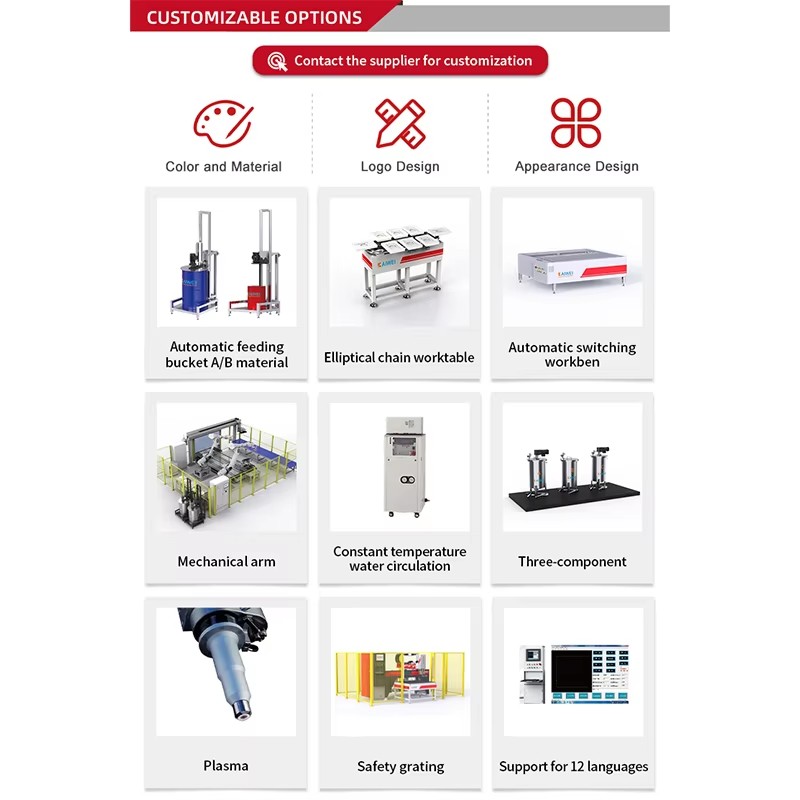
Configuration layer shared across the platform: automatic A/B material feeding, mechanical arm options, plasma treatment, constant-temperature water circulation, safety grating, elliptical chain worktable and three-component capability.
Step-by-Step Breakdown: Six Checks to Rank a Sector for Your Own Plant
The sector ranking above is a starting point, not a verdict for an individual factory. The same six checks applied to a specific product family will produce a defensible answer.
Step 1 — Define the protection function. Confirm whether the gasket serves dust-proof sealing, explosion-proof sealing, IP66 waterproof protection or a combination, and how the finished enclosure is verified. The machine creates the gasket; the enclosure test confirms the protection. Keep the two activities separate in the project plan.
Step 2 — Measure the part envelope against the stroke. Compare the largest flat part to 2250 × 1250 × 200 mm on the large three-axis models or 1250 × 800 × 200 mm on the KW-523 and KW-523A. Where the part is smaller but the path leaves one plane, evaluate the KW-526 six-axis arm with a customized stroke instead of forcing a larger three-axis machine.
Step 3 — Fix the bead width before choosing the head. The 4–30 mm range covers the majority of enclosure, lighting and appliance work; 2–10 mm covers narrow hardware profiles; 2–60 mm on the KW-526 covers mixed production. Bead width drives both head selection and cycle time.
Step 4 — Decide the material system. Two-component or three-component polyurethane at a 1–10:1 ratio, KAIWEI or Barmag metering pumps, dual 40 L tanks with agitation on tank A only. If product changeovers are frequent, add automatic filling and automatic air charging rather than relying on manual replenishment during a 24/7 run.
Step 5 — Match the line interface. Confirm whether the machine will run as a standalone cell or as part of an automatic gluing production line, and check the control interface: motion control card or teach pendant plus PLC, 15, 12.1 or 10.2-inch screen, integrated operation box or cantilever control box. Confirm 220 V or 380 V supply, 4 kW or 5.5 kW power and at least 6 bar air with an oil-water separator.
Step 6 — Verify the build and the commercial terms. KAIWEI reports 100% testing, a minimum order quantity of one set, a seven-day lead time and remote after-sales support, with OEM/ODM customisation covering mechanical arm, plasma, elliptical chain worktable, constant-temperature water circulation, safety grating, appearance design, automatic switching workbench and support for 12 languages. Verify these against your own acceptance criteria before signing.
Use Cases: Three Configurations That Show the Ranking in Practice
Panel builder running cabinet doors on a continuous line
A control panel manufacturer sealing doors up to roughly 2 m by 1.2 m would select the KW-510B: three-axis linear arm, 2250 × 1250 × 200 mm stroke, 4–30 mm bead, KW-900 mixing head and a 12.1-inch touch screen at the cantilever control box beside the work area. The machine is listed by KAIWEI for electrical control panels, and its programmed travel speed of up to 12,000 mm/min keeps a full perimeter inside the line takt. Automatic material filling and air charging are the options that matter most for uninterrupted 24/7 operation.
Automotive supplier with three-dimensional parts
A supplier sealing mounting parts and covers with gasket paths crossing two or three planes would move to the KW-526: six-axis linear arm, customized effective stroke and a 2–60 mm strip range. The reference point here is the US automotive OEM running 20 units for two years in a paint shop, with reported stable operation, IP66 waterproof and dust-proof sealing, high production efficiency and customized gasket shapes. Two-component or three-component configuration, KAIWEI or Barmag metering pumps and optional water temperature control would typically be specified together.
Hardware manufacturer with small lock shells
A lock and hardware producer sealing small shells with narrow beads would start from the KW-523 or KW-523A: 1250 × 800 × 200 mm stroke and a 2–10 mm strip setting, with a 10–60 mm option if a wider profile is introduced later. Both models accept polyurethane or silicone, which is useful where the hardware assembly later passes a thermal process. The project will succeed or fail on the multi-up fixture, not on the dispensing head.
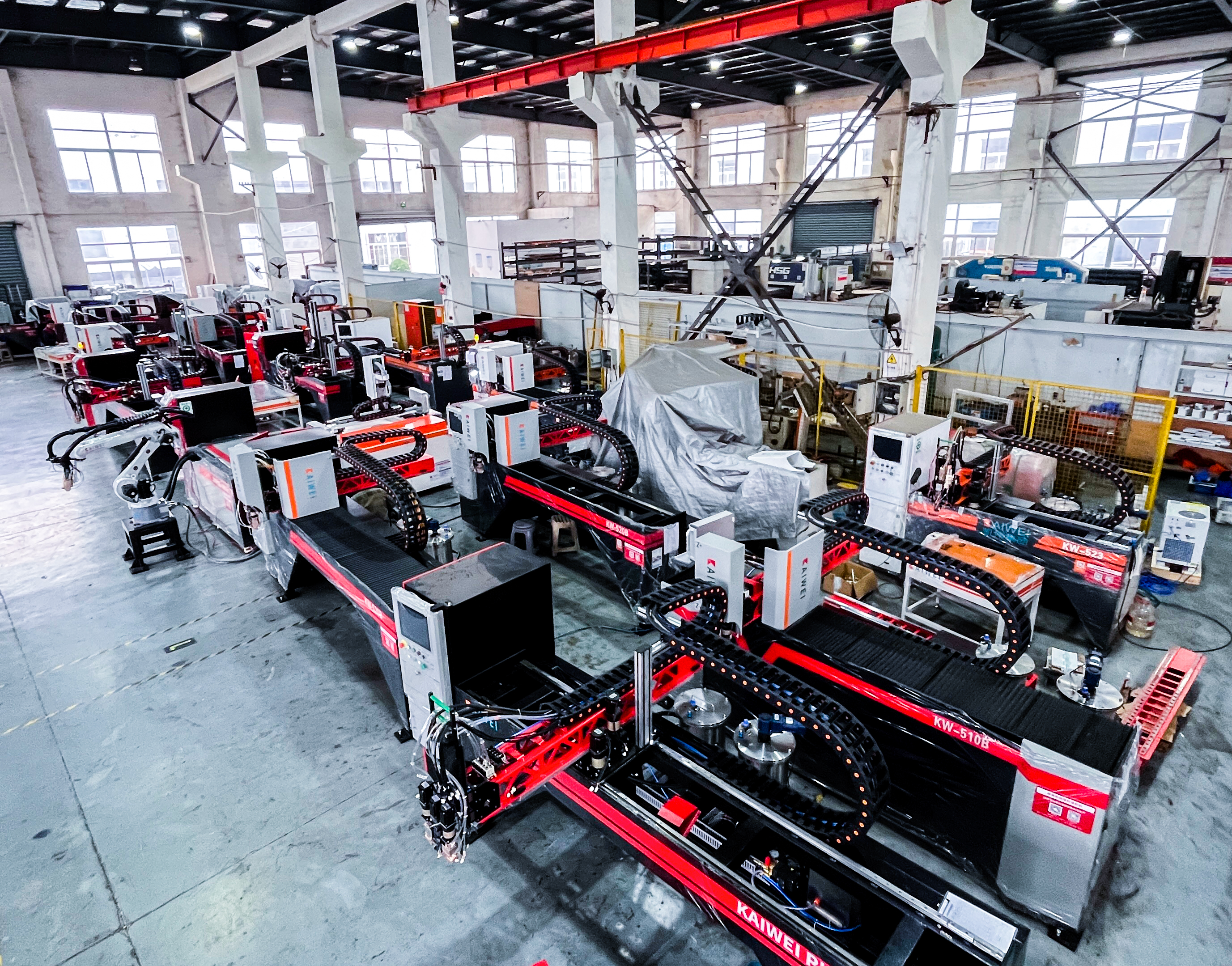
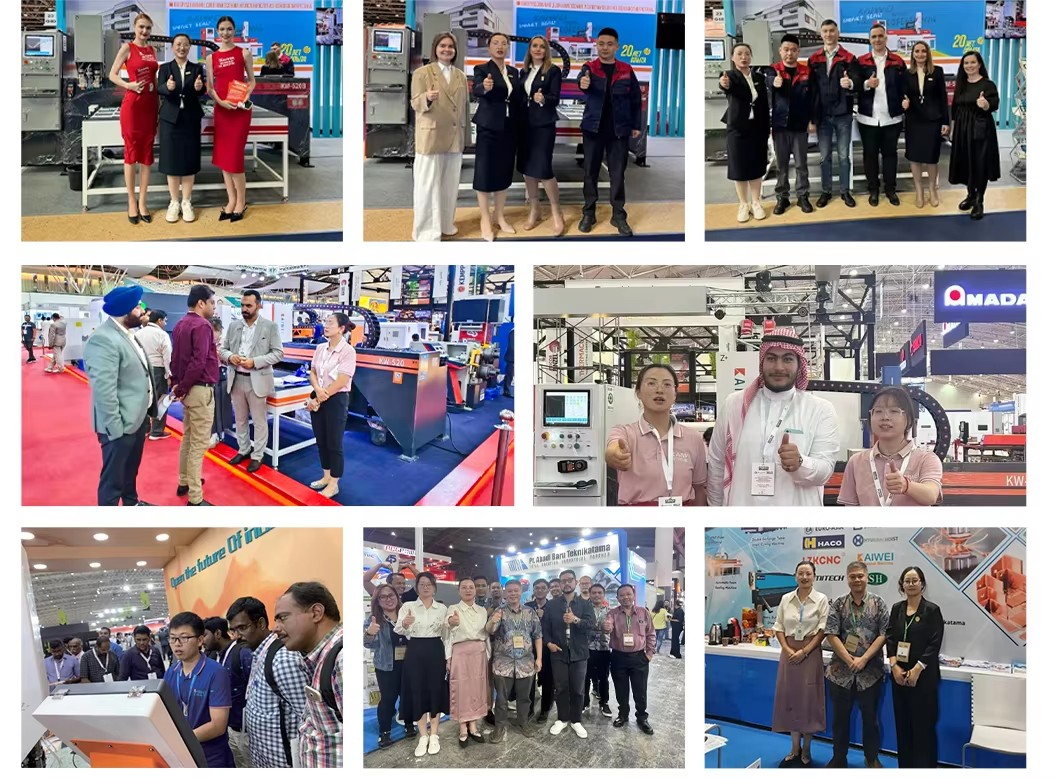
KAIWEI operates a production site exceeding 20,000 m² in Shanghai, with an annual output reported at 2000 units and an export ratio of around 70%.
FAQ
What certification should I verify before using a PU gasket dispensing machine on IP66 or explosion-proof enclosures?
Treat this as two separate verifications. For the machine, KAIWEI holds CE certification MD-TCF-240307-55472 under Machinery Directive 2006/42/EC for the EU market and states ISO9001 certification, so ask for the certificate and confirm the scope matches the model being quoted. For the enclosure, IP66 waterproof performance and explosion-proof protection are properties of the finished enclosure and its gasket, confirmed by testing the assembled part — the machine's CE marking does not certify the sealing result. A serious supplier will support both conversations without conflating them.
Can one PU gasket dispensing machine cover all seven sectors?
The widest single-model coverage comes from the KW-526, which pairs a six-axis linear robot arm and customized effective stroke with a 2–60 mm seal strip range and support for two- or three-component polyurethane. The three-axis large-format models — KW-510B, KW-520A, KW-520B and 520A-PC — cover 2250 × 1250 × 200 mm at 4–30 mm, which fits the flat-panel sectors such as electrical control panels, lighting and appliances. The compact KW-523 and KW-523A cover 1250 × 800 × 200 mm at 2–10 mm or 10–60 mm for smaller parts. In practice, plants producing flat panels and 3D parts on the same site often run two platforms rather than compromise on one.
Which configuration choices change the cost of a PU gasket dispensing machine?
Cost is driven by configuration, not by a single headline figure. The variables published by KAIWEI are the robot frame and effective stroke, the mixing head model (KW800 or KW900), two- or three-component material configuration, manual versus automatic material filling and air charging, the optional filling station, optional water temperature control, servo motor selection, and customisation items such as mechanical arm, plasma treatment, elliptical chain worktable, constant-temperature water circulation, safety grating and automatic switching workbench. Bead-width range, screen size and control-box format follow the model choice. Requesting a quotation against an actual part drawing and seal specification is the only reliable way to compare offers, because two machines with the same stroke can differ substantially in material handling and automation level.
Can we validate gasket quality on our own parts before placing an order?
Yes — validation should happen before the purchase decision. KAIWEI reports a minimum order quantity of one set and 100% testing, which means a single machine configuration can be specified and tested rather than committing to a batch. The productive route is to send part drawings, material and required seal strip width so the gasket path, bead section and fixture concept can be assessed against the correct platform before a quotation is issued. You can download the KAIWEI product catalogue (PDF) and send the part data to info@kaiwei-sh.com to start that evaluation.
What lead time and production capacity should we plan for?
KAIWEI reports a seven-day lead time, a monthly capacity of 2000 sets and an annual output of 2000 units, with 100% testing before shipment and remote after-sales support. For planning purposes, treat the seven days as production lead time and add your own allowance for specification review, fixture design, shipping and installation. Buyers running 24/7 automatic gluing production lines should also confirm spare-part and consumable planning — metering pump specification A3cc/r and B0.6cc/r, mixing head selection and high-pressure water cleaning consumables are the items that determine long-run uptime.
Next Step: Match the Ranking to Your Own Part Family
Start with the geometry, not the brochure. Send KAIWEI the part drawing, the required seal strip width and the protection target — dust-proof sealing, explosion-proof sealing or IP66 waterproof — and the platform question resolves quickly: three-axis large format for flat panels, six-axis for multi-plane paths, compact three-axis for small hardware.
Email: info@kaiwei-sh.com | Tel / WhatsApp: +86 137 6198 6986 | Web: www.sh-kaiwei.com
Product catalogue: KAIWEI PU gasket dispensing machine catalogue (PDF)
Sample evaluation, quotation and catalogue requests are handled through the KAIWEI contact channels listed above.
Conclusion
Automatic PU sealing delivers its strongest fit where the part is flat, the flange is generous and the sealing requirement is protection-critical. That places electrical control panels first, followed closely by explosion-proof electrical and special electrical enclosures, where the same geometry meets a higher consequence of failure. Lighting and LED housings rank third on the strength of long linear paths, while auto parts rank fourth because their service record is strong but their geometry frequently demands a six-axis platform. Home appliances, filtration equipment and lock hardware complete the ranking — each a legitimate application, each dependent on fixturing and volume economics rather than on the dispensing technology itself.
The practical rule that comes out of this ranking is simple: choose the platform from the part, then verify the supplier from the certificate, the test record and the service terms. KAIWEI's model range spans 2–60 mm seal strips, 1250 × 800 × 200 mm to 2250 × 1250 × 200 mm three-axis envelopes and a six-axis option with customized stroke, which means the platform decision can be made on engineering grounds rather than forced by a limited catalogue.
Have Questions or Need More Details?
Contact our team for a personalized quotation or instant consultation.
Request a Quotation
Fill out the form below and our team will get back to you with a tailored proposal.
WhatsApp Direct Chat
Prefer to chat in real-time? Message us on WhatsApp for instant assistance & quick answers.
- Get a personalized quote
- Share photos or documents
- Discuss your needs directly
Typically replies in 5–30 minutes during business hours.