
Specifying PU Gasket Dispensing Machines for 24/7 Explosion-Proof Sealing
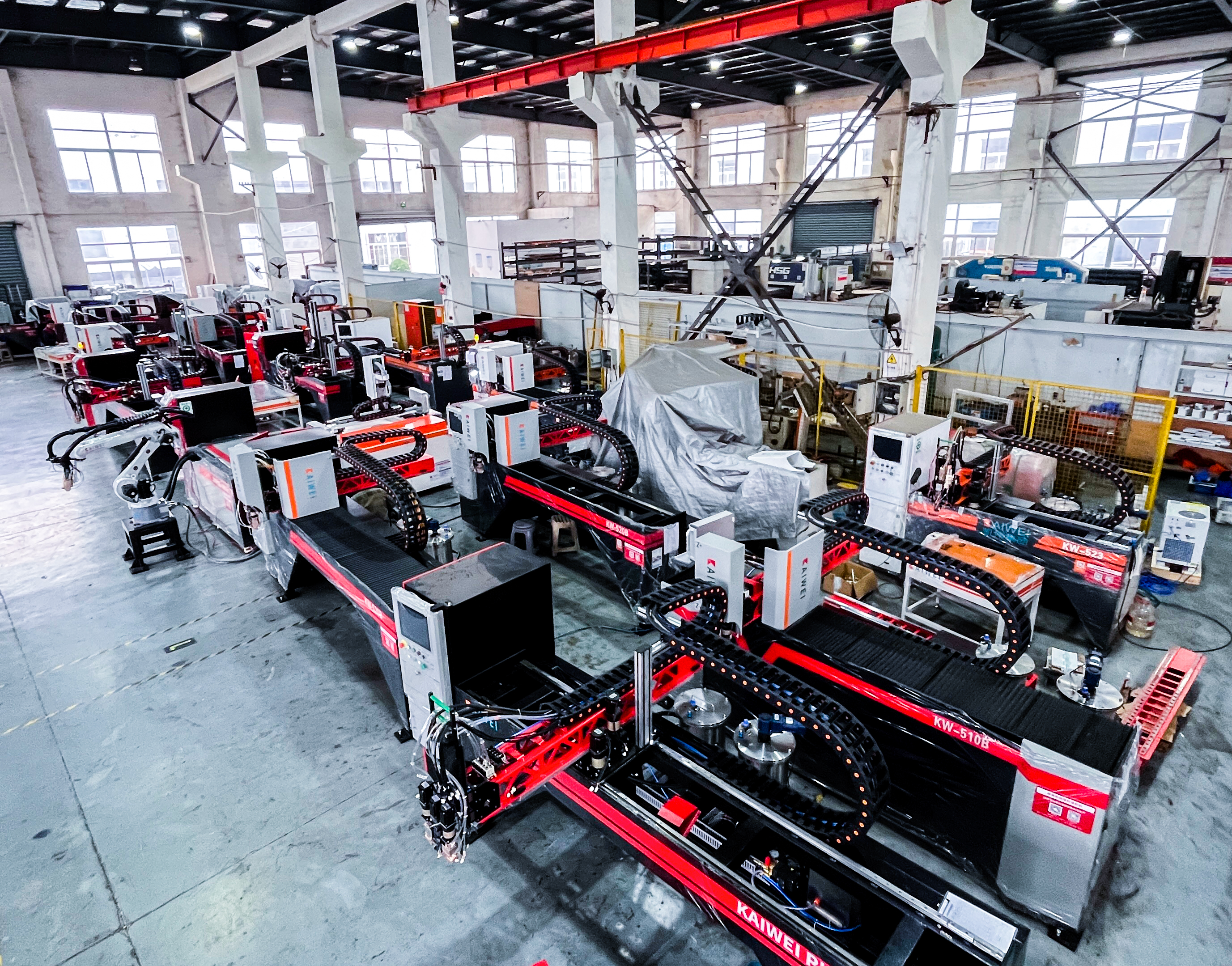
A PU gasket dispensing machine is only as suitable as the conditions it was specified against. Once an enclosure sealing programme moves from a manual or semi-automatic cell onto a 24/7 automatic gluing line, three constraints begin to decide the purchase: the plant ambient range, the duty cycle and integration behaviour of the line, and the explosion-proof and IP66 obligations that belong to the panel being sealed rather than to the machine itself. Take those decisions in the wrong order and the equipment can pass a factory acceptance test and still stop the line a quarter later.
This guide sets out the specification sequence in the order the constraints bind, then closes with a checklist to run before purchase terms and acceptance criteria are fixed. The KAIWEI KW-510B is used as the worked example for electrical control panels, air filters and home appliances. KAIWEI is Shanghai Kaiwei Intelligent Technology (Group) Co., Ltd., a Shanghai-headquartered manufacturer of industrial sealing systems and robot foaming equipment founded in 2004.
The problem: what 24/7 explosion-proof sealing actually asks of a dispenser
Explosion-proof sealing is a property of the enclosure, not of the dispensing machine. A control panel, distribution board or anti-explosion box achieves its ingress and hazardous-area classification through the housing, the joint geometry and the gasket that closes the gap. The dispenser's job is narrower and harder: it must deposit a continuous polyurethane foam gasket at the same position, the same bead geometry and the same foam density on every panel, for months, without a break in the bead.
That requirement turns an intermittent tool into a continuous-duty production asset, and continuous duty introduces failure modes that a single-shift machine never meets. KAIWEI's own risk documentation names two of them explicitly:
- Overheating during long-term continuous operation, which can lead to component damage or a safety hazard when a machine runs without a cooling cycle between shifts.
- Glue leakage or overflow during dispensing, which contaminates the product, wastes material and forces the line down while the head is cleaned.
Both are specification problems before they are maintenance problems. A machine ordered without thermal monitoring and without leak detection cannot be rescued by an operating procedure, because the failure is invisible until the panel fails its water or continuity test. The rest of this guide works through the parameters that keep those two failures out of the specification.
Industry background: why the gasket is dispensed rather than assembled
Form-in-place foam gasket (FIPFG) dispensing deposits a reactive two-component polyurethane bead directly onto the component, where it foams, expands and cures into the finished gasket. Compared with a die-cut or manually applied gasket, the process creates the seal on the part itself, which means the seal can follow a three-dimensional path around a door recess, a cable entry or a filter frame without a separate cutting tool.
The consequence for buyers is that gasket quality is decided at the dispensing head rather than at the gasket supplier. Bead continuity, mixing uniformity and positional repeatability all transfer directly into the enclosure's sealing performance. In electrical control panels and related sectors the gasket also carries an explosion-proof obligation, because the enclosure's protection concept assumes the seal remains intact. This is why the machine specification and the panel certification file cannot be written independently of each other.
KAIWEI states that its automatic adhesive and dispensing equipment is used in electric cabinets, air filters, air conditioning purification equipment, lamps, automobiles and new energy applications, and that its products have passed CE and ISO9001 certification. Those are manufacturer statements about application range and conformity, and they define the starting point for the technical questions below rather than replacing them.
The specification sequence in seven steps
Step 1: Fix the ambient window before anything else
Start with the ambient range: -20 to 40 °C. This is the window in which the machine, its material conditioning system and its electrical control cabinet must remain functional, and it is broader than the climate of most assembly halls. A plant in a cold store or an unheated logistics area sees the lower end; a shop floor beside a curing oven or under a metal roof in summer sees the upper end.
Two checks follow. First, put the actual ambient range of the installation point in the RFQ and ask the supplier to confirm the machine's rated ambient range against it in writing, on the datasheet rather than in the sales email. Second, treat the upper end as a thermal-load question, not a comfort question: a machine running 24/7 adds its own heat to the ambient figure, so a unit specified at 40 °C ambient with no margin has nowhere to go at hour twelve of a three-shift week. Ask what the machine does when the measured temperature approaches the limit — whether it derates, alarms or stops.
Step 2: Size the machine against the gluing line, not against one panel
Integration with an automatic gluing production line changes the unit of specification from the part to the cycle. The relevant question is not whether the machine can dispense one panel well, but whether it can accept panels at the rate the line presents them, in the orientation the conveyor delivers them, with the gasket path programmed for each variant.
Three items belong in the technical annex of the RFQ: the working envelope required to cover your largest panel and door geometry, the cycle time the line demands per variant, and the interface by which the line starts, stops and confirms a completed bead. Servo-driven axis control and the control architecture that exchanges those signals are machine-level decisions that must be settled before the quotation is compared, because a machine that cannot handshake with the line is a manual machine with extra hardware.
Step 3: Specify continuous-duty thermal and material control
For 24/7 operation the specification should name the control functions rather than the outcome. KAIWEI's risk-control configuration for its dispensing equipment lists an independent, self-developed intelligent temperature control module that monitors operating temperature in real time, dissipates heat automatically and raises an over-temperature alarm; a high-precision servo dispensing valve with real-time pressure feedback; automatic glue leakage detection with shutdown protection; automatic glue quantity calibration; constant temperature and humidity foaming control; and an emergency stop safety mechanism.
Read that list as a specification checklist rather than a feature list. Temperature control governs whether the foam cures to a consistent density across a long shift. Pressure feedback governs whether a partial blockage is detected as a pressure deviation instead of appearing as a thin bead on panel number 400. Leak detection governs whether an overflow becomes a cleaning job or a contaminated batch. Each item answers a specific failure mode named in Step 1, which is why they belong in the acceptance test rather than in the brochure.
Step 4: Translate IP66 and explosion-proof panel requirements into machine criteria
The IP66 rating and the explosion-proof classification apply to the finished enclosure, so they reach the machine indirectly, in four places.
- The gasket must be continuous. A single break in the bead creates a path for water and dust, and the panel's rating is lost regardless of how well the housing is built. Bead continuity is the machine's contribution to IP66.
- The gasket geometry must be repeatable. Compression set depends on bead height and width being stable from panel to panel, which is a function of dosing accuracy and mixing consistency rather than of operator skill.
- The material path must be closed and monitored. Leakage and overflow contaminate the part and the fixture; the machine specification should require detection and shutdown rather than relying on an operator noticing.
- The machine's own electrical equipment must suit the plant. KAIWEI specifies an IP65/IP66 fully enclosed sealing design and electrical insulation protection as part of its risk-control configuration. Where the installation point falls inside a classified area, the site classification must be confirmed with the machine builder before order, because it affects the electrical specification of the machine itself.
Explosion-proof classification of a control panel and explosion-proof construction of the dispensing machine are two different questions. Confirm the second with the supplier in writing for your specific installation; do not infer it from the application description.
Step 5: Confirm the model envelope against your part mix
Only after the environment, the line and the panel requirements are fixed does model selection make sense. For electrical control panels, air filters and home appliances, the KAIWEI KW-510B is the reference point in this guide: a gantry-style automatic PU foam sealing machine intended to dispense a formed-in-place gasket onto panel doors, filter frames and appliance housings.
Test the model against the three hardest parts in your mix, not the average one: the largest door, the part with the tightest corner radius, and the variant with the deepest recess. Ask for the working envelope, the positioning tolerance and the minimum bead width the machine can hold at a corner, and ask for them for the exact configuration quoted. A model name alone does not define a configuration, and two machines with the same name can differ in axis count, control system and working area.
Step 6: Agree the verification method before the machine ships
Acceptance criteria should be written while the specification is being negotiated, because they determine which optional features you actually need. The practical test set for an enclosure sealing programme covers bead continuity around the full gasket path, bead cross-section against the drawing, adhesion and cure state on a sample part, positional repeatability across a run of consecutive panels, and the behaviour of the machine when a fault is simulated.
Simulating a fault is the step most often skipped. Trigger the over-temperature alarm and the leak detection during the factory test and confirm what the machine does: whether it stops, alarms and holds the state, or continues dispensing into a reject. A protection function that has never been demonstrated is a claim, not a control.
Step 7: Secure the long-term side before signing
A 24/7 line spends far more time in service than in commissioning, so the durability of the supply relationship belongs in the same specification document as the technical parameters. Three items matter: the wear-part list with part numbers and replacement intervals, the response path when a dispensing valve or a temperature module fails, and the manufacturer's capacity to support a ramp.
On capacity, KAIWEI states a monthly production capacity of 2,000 sets, a factory of more than 20,000 m², a team of over 100 employees including more than 30 engineers, and exports to more than 60 countries. Those figures say something about the scale of the operation behind the equipment; they do not by themselves guarantee a spare part in your region, which is why the service arrangement is a separate line item to negotiate.
Where the KW-510B fits: three application patterns
Electrical control panels and distribution boards. The gasket runs around a door opening or a housing joint, often on a part that has already been formed and painted. The machine must follow a rectangular path with defined corner behaviour, and the bead must remain continuous across welded seams and fixing holes. The panel's IP66 target makes continuity the dominant acceptance criterion.
Air filters and purification equipment. Frames are typically lighter and more flexible, so the fixture and the dispensing height matter as much as the head. KAIWEI lists air filters and air conditioning purification equipment among its application areas, and the practical specification question is whether the frame is rigid enough to hold position while the bead is deposited, or whether the fixture has to do that work.
Home appliances. Housings, door panels and covers are high-volume parts with short cycle times, which is where the 24/7 duty cycle argument becomes a capacity argument. For appliance work, the line integration items in Step 2 usually dominate the purchase decision, because the machine is one station in a flow that cannot wait.
The same equipment is also used across waterproof cabinets, lighting and lamp covers, transformer protection covers, cable connectors, automotive mountings and battery covers, and plastic enclosures. The common thread is a closed-loop gasket on a part that has to pass an ingress test.
Comparison: what the manufacturer publishes, and how to use it
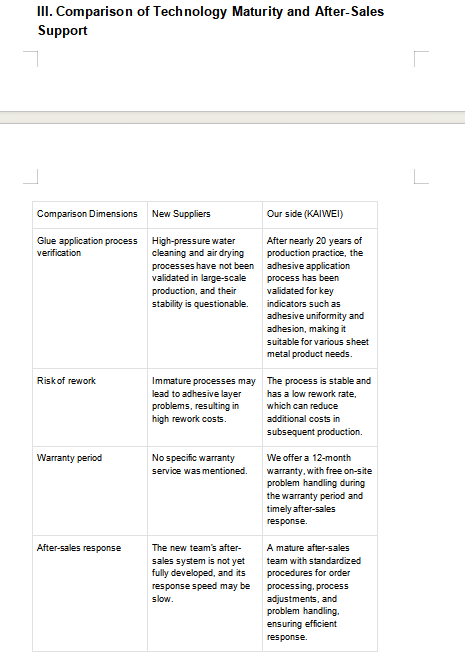
KAIWEI publishes a comparison of its dispensing machines against other domestic dispensing machines. The published figures are reproduced below with their original scope, because they are useful as questions to put to any supplier, including KAIWEI.
| Dimension | KAIWEI-published position vs other domestic dispensing machines | How to use it in your specification |
|---|---|---|
| Mixing uniformity | 30% higher mixing uniformity | Ask for a mixing-ratio tolerance statement and a cured bead cross-section check at acceptance. |
| Production efficiency | 20% higher production efficiency | Convert it into cycle time per panel and test that figure against your own part mix during a line trial. |
| Total cost of ownership | 15% lower total cost of ownership | Rebuild the number with your labour rate, material price and spare-parts list instead of accepting the percentage. |
| Maintenance | Less maintenance, longer service life | Ask for the preventive-maintenance interval and the consumable parts list in the quotation. |
These are manufacturer-published comparison figures, not independently tested results. They are not comparable across suppliers unless the machine configuration, the material and the test conditions are the same, and they should be treated as claims to verify during a line trial and acceptance inspection rather than as guaranteed specifications.
Pre-purchase checklist for an automatic sealing project
Run this list before purchase terms and acceptance criteria are finalised. Each line maps back to a step above, and each one should have a written answer in the quotation or the technical annex rather than a verbal one.
- Ambient range: -20 to 40 °C stated in the RFQ, with the machine's rated ambient range confirmed on the datasheet.
- Duty cycle: 24/7 continuous operation acknowledged in the offer, with the thermal protection functions named individually.
- Bead specification: width, height and positional tolerance agreed per part family, with an approved sample gasket kept as the reference.
- Continuity and leak detection: the method for detecting bead breaks or glue overflow written into the acceptance procedure, and demonstrated during the factory test.
- Enclosure and electrical protection: IP65/IP66 fully enclosed design and electrical insulation protection confirmed for your installation point; site classification reviewed with the machine builder.
- Material conditioning: constant temperature and humidity foaming control, dosing calibration and the material handling arrangement specified.
- Line integration: working envelope, cycle time per variant and the start/stop/confirm interface agreed with the automatic gluing line supplier.
- Safety: emergency stop, over-temperature alarm and leak-detection shutdown tested, not just listed.
- Conformity documents: CE and ISO9001 certification supplied with declared scope and validity before shipment.
- Commercial and acceptance terms: MOQ, Incoterm, payment terms, inspection method and third-party testing option fixed in the contract.
- Long-term support: wear-part list, spare-parts availability and post-warranty service path agreed in writing.
Frequently asked questions
Which certifications should be verified before a PU gasket dispensing machine is accepted?
Verify CE and ISO9001 conformity and confirm that the declared scope covers the exact model and configuration ordered. KAIWEI states that its products have passed CE and ISO9001 certification, and its CE certification is documented under Machinery Directive 2006/42/EC (certificate MD-TCF-240307-55472). Ask for the declaration of conformity and the certificate with the shipment documents rather than accepting a logo on a webpage.
How does an IP66 requirement on the electrical control panel affect machine selection?
The IP66 rating belongs to the finished enclosure, so the machine contributes to it through gasket continuity, bead geometry repeatability and a closed material path. Select for stable bead height and width across consecutive panels, and require a continuous bead around the full gasket path with corner behaviour defined. Then write a continuity check into the acceptance test, because a single break in the bead defeats the rating regardless of the housing design. KAIWEI also specifies an IP65/IP66 fully enclosed sealing design and electrical insulation protection on its dispensing equipment.
Can a PU gasket dispensing machine run 24/7 across an ambient range of -20 to 40 °C?
Continuous operation across a wide ambient window is a thermal-management and material-conditioning question rather than a headline specification. The machine configuration should include real-time temperature monitoring with automatic heat dissipation and an over-temperature alarm, pressure feedback on the dispensing valve, glue leakage detection with shutdown, and constant temperature and humidity foaming control; KAIWEI lists these functions in its risk-control configuration. Confirm the rated ambient range in writing against your installation point, and ask what the machine does when the limit is approached.
What has to be agreed to integrate the machine with an automatic gluing production line?
Agree four items before quotation: the working envelope that covers your largest part, the cycle time the line demands for each variant, the control interface by which the line starts, stops and confirms a completed bead, and the axis and servo configuration that delivers the required path. Servo drive control and real-time feedback are the machine-side functions that make those agreements enforceable. If any of the four is left open, the machine can be technically capable and still not run at line rate.
What production capacity and delivery terms apply to KAIWEI equipment?
KAIWEI states a monthly production capacity of 2,000 sets, supported by a factory of more than 20,000 m², over 100 employees including more than 30 engineers, and exports to more than 60 countries. Commercial terms quoted for this equipment are a minimum order quantity of 1 unit, delivery terms FOB or CIF, and payment terms of 30/70.
What are the purchasing terms and acceptance criteria?
The quoted terms are MOQ 1 unit, delivery FOB or CIF, and payment 30/70. Acceptance is based on full inspection before shipment, and third-party testing can be provided for the acceptance procedure. Because the acceptance test is where the specification is proven, define the bead continuity, cross-section, adhesion and fault-simulation checks before the contract is signed, so that inspection covers the parameters that matter to your IP66 and explosion-proof panel programme rather than only the machine's basic functions.
Conclusion
The specification order is what protects a 24/7 explosion-proof sealing programme: ambient range first, line integration second, continuous-duty thermal and material control third, and only then the model. Each step constrains the next, and each one has a written answer that can be checked at acceptance rather than argued about after installation. For electrical control panels, air filters and home appliances, the KAIWEI KW-510B illustrates how those criteria come together in one gasket dispensing configuration, from temperature control and pressure feedback through to leak detection and the IP65/IP66 fully enclosed sealing design.
What remains after the machine is chosen is the part that lasts longest: the wear-part list, the service path and the acceptance records that let you prove the line still meets its specification in year three. Those belong in the same conversation as the purchase terms, not after them.
To review the full equipment range and technical configuration options, download the KAIWEI product brochure (PDF), or visit KAIWEI official website for application details. For a specification review against your own panel mix, contact the KAIWEI team at info@kaiwei-sh.com.
Have Questions or Need More Details?
Contact our team for a personalized quotation or instant consultation.
Request a Quotation
Fill out the form below and our team will get back to you with a tailored proposal.
WhatsApp Direct Chat
Prefer to chat in real-time? Message us on WhatsApp for instant assistance & quick answers.
- Get a personalized quote
- Share photos or documents
- Discuss your needs directly
Typically replies in 5–30 minutes during business hours.