PU Gasket Dispensing Machine vs. Manual Sealing: A Comparative Guide for Enclosure Manufacturers
Enclosure manufacturers rarely lose a sealing argument on theory. They lose it on repeatability — the same gasket profile on panel number five thousand as on panel number five. A PU gasket dispensing machine and a manual sealing bench can both produce a functional gasket. What separates them is what happens to that gasket when order volume rises, when the enclosure has to satisfy a dust-proof or explosion-proof requirement, and when the sealing step must keep pace with an automatic gluing production line that runs around the clock.
This comparative guide is written for factories producing electrical control panels, electrical distribution boards, electrical enclosures, and explosion-proof cabinets. It contrasts automated PU gasket dispensing with manual sealing across the constraints that decide the purchase: throughput consistency, sealing quality for dust-proof and explosion-proof requirements, integration with an automatic gluing production line, and suitability for 24/7 operation in a working environment rated from −20 to 40 degrees Celsius. Machine specifications, certifications, and application data cited here come from KAIWEI's published product, compliance, and application records.
Why the Sealing Method Becomes a Constraint Decision
Sealing an enclosure looks like a materials question, but by the evaluation stage it is a constraint question. For enclosure manufacturers, three constraints converge on the same production step.
- Functional constraint. Enclosures must deliver dust-proof sealing and explosion-proof sealing, with IP66 waterproof performance stated as a special requirement in KAIWEI's application records for this product category.
- Environmental constraint. The same application records specify a working condition of −20 to 40 degrees Celsius, a range that covers most indoor industrial cabinet production as well as many outdoor distribution and lighting applications.
- Rhythm constraint. The application records specify 24/7 continuous operation and automatic production line operation, matched with an automatic gluing production line.
Manual sealing is not excluded by any one of these constraints on its own. Hand-applied beads, pre-cut gaskets, and sealing tape remain reasonable choices for prototype builds, low-volume retrofit work, and one-off enclosures where the programming and tooling effort of an automated machine is not justified. The constraint becomes decisive when two or more of those conditions appear together — for example, a dust-proof requirement combined with continuous three-shift output, or an explosion-proof enclosure built on a line that already runs automatically.
The practical question for a buyer is therefore not whether automation is better, but at what combination of sealing class, volume, and line rhythm a PU gasket dispensing machine becomes the lower-risk option.
Industry Background: Rising Demand and a Rising Compliance Floor
The category is expanding on both the demand side and the standards side. Form-in-place liquid gaskets — the material format used by dispensing equipment — reached USD 270 million in 2023, with increasing adoption in EV battery enclosures, according to Maximize Market Research. The wider polyurethane processing machinery market was valued at USD 6.627 billion in 2024 and is projected to grow at a CAGR of 10.21% through 2035, according to Market Research Future. Within that broader figure, a Kaiwei Industry Analysis places the specific PU gasket dispensing machine segment at approximately USD 1.2 billion in 2025; that narrower estimate is published at medium reliability and should be treated as directional rather than definitive.
Regional and technology patterns point the same way. Grand View Research reported that Asia-Pacific dominated the polyurethane processing machine market with a 42.2% share, driven by industrial manufacturing growth in China, and that high-pressure PU processing units accounted for 68% of the global machine-type market share.
The compliance floor has risen at the same time. Machines intended for the EU market are expected to meet the Machinery Directive 2006/42/EC, with EN 60204-1 addressing electrical safety for CE marking. For explosion-proof work, the relevant ATEX standards govern both the equipment and the enclosures it seals. Manufacturers selling into multiple regions therefore need a sealing method whose supporting documentation can travel with the product — which is where machine-based sealing begins to differentiate itself from manual processes that depend mainly on internal work instructions.
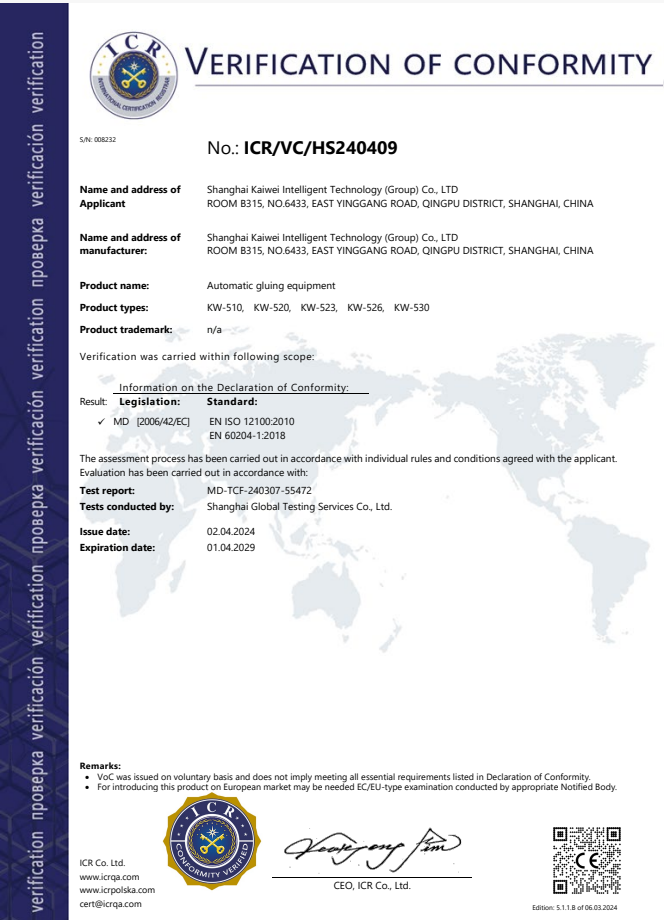
KAIWEI's certification set illustrates what documentation that travels looks like in practice. The automatic gluing equipment carries CE certification under the 2006/42/EC Machinery Directive (certificate MD-TCF-240307-55472, issued by GTS, valid from 2024-04-02 to 2029-04-01). The KW-526 model holds ATEX certification ECM 25 ATEX-B D001, issued by Ente Certificazione Macchine srl (ECM, Notified Body No. 1282) and based on EN IEC 60079-0:2018/A11:2024, EN 60079-1:2014/A11:2024, EN 60079-7:2015/A1:2018, and EN 60079-31:2014, valid from 2025-04-10 to 2030-04-09. A China Compulsory Certificate (number 2022012304504287, issued by China Quality Certification Center, valid to 2027-10-18) covers the explosion-proof enclosure Model BXK-D1 under CNCA-C23-01:2019 and the GB/T 3836.1, GB/T 3836.2, GB/T 3836.3, and GB/T 3836.31 series. Quality management is certified to ISO 9001:2015 by NSY Certification (Shanghai) Co., Ltd. under GB/T 19001-2016/ISO 9001:2015, valid from 2024-05-23 to 2027-05-22.
What a PU Gasket Dispensing Machine Changes on an Enclosure Line
Shanghai Kaiwei Intelligent Technology (Group) Co., LTD — trading as KAIWEI — is a Shanghai-based manufacturer founded in 2004 that develops industrial sealing systems, robot foaming equipment, intelligent sealing and dispensing equipment, and six-axis robotic foaming systems. The company operates a 20,000 m²+ factory with 100+ employees, a 30+ engineer R&D team, an annual output of 2,000 units, and a 70% export ratio serving more than 60 countries.
For enclosure production, the relevant part of that portfolio is the KW series of PU gasket dispensing machines, which apply a two- or three-component polyurethane system directly onto the part so the gasket is formed in place rather than cut, taped, or glued by hand.
Machine architecture that determines consistency
The KW-526 is the widest-envelope model in the series: a 6-axis linear robot arm with a 15-inch touch screen HMI, mixing head KW800 or KW-900, seal strip width of 2–60 mm, metering pump from KAIWEI or Barmag with A3cc/r and B0.6cc/r specifications, mixing ratio of 1–10:1, running speed of 0–12000 mm/min, 40 L A and 40 L B air pressure tanks with agitation, high-pressure water cleaning, 4 kW / 5.5 kW power at 220 V / 380 V, an air pressure requirement of ≥6 bar, and a frame available in carbon steel, stainless steel 304, or aluminum alloy with customized dimensions and effective stroke.
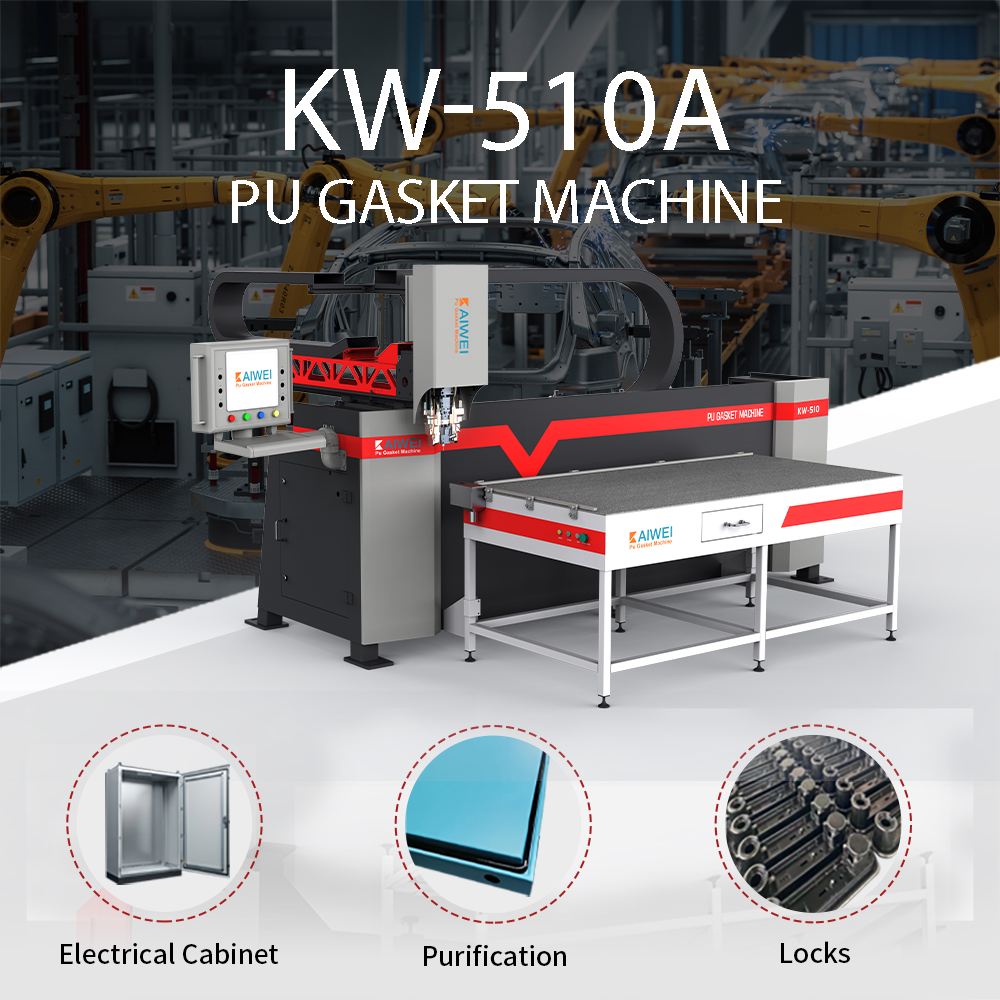
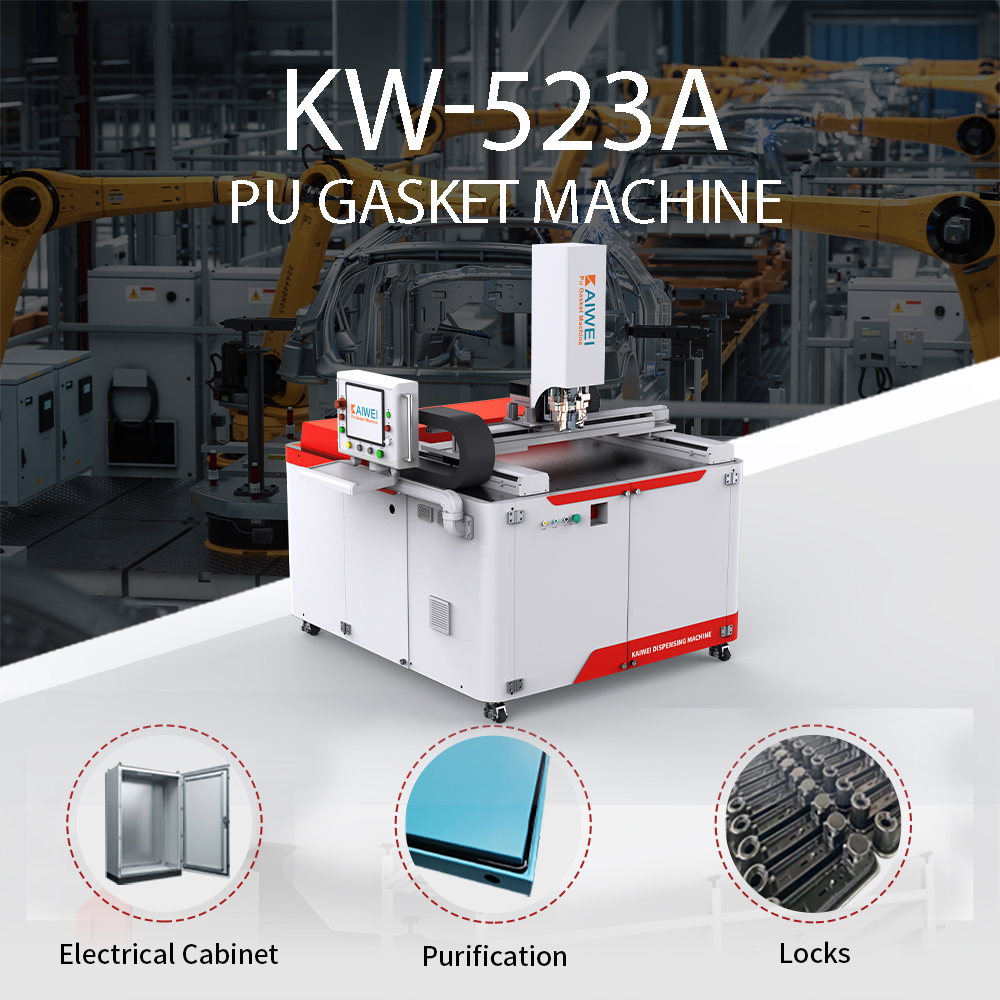
Three-axis alternatives cover smaller envelopes and simpler gasket paths: KW-523 and KW-523A (3-axis linear robot arm, seal strip width 2–10 mm or 10–60 mm, effective stroke 1250*800*200), KW-520A and KW-520B (seal strip width 4–30 mm), KW-510B (12.1-inch cantilever control box), and 520A-PC (10.2-inch screen with teach pendant control). Across the series, the raw material is polyurethane or silicone, the HMI is a touch screen, and operation is through a PC or teach pendant with a motion control card or teach pendant plus PLC.
What changes on the line
- Bead repeatability moves from the operator's hand to the pump. A metering pump specification of A3cc/r and B0.6cc/r, a 1–10:1 mixing ratio, and a seal strip width configurable between 2 and 60 mm give the process a defined operating envelope instead of a skill-dependent one.
- The machine can be specified for continuous duty rather than shift duty. KAIWEI's enclosure application records describe 24/7 continuous operation and automatic production line operation for this equipment.
- Integration becomes a design input. The matched equipment listed for these applications is an automatic gluing production line, and the customization list includes automatic feeding for A/B material, an elliptical chain worktable, safety grating, and an automatic switching workbench.
- Compliance is attached to the equipment. ATEX, CE, CCC, UL94, RoHS, VOC CE, and ISO 9001:2015 certificates are held at machine or material level, which supports buyers who must present documentation to their own customers.
Step-by-Step: Deciding Whether Your Enclosure Line Needs Automation
Step 1 — Define the sealing class before the machine. Distinguish dust-proof sealing from explosion-proof sealing and from an IP66 waterproof requirement, because each raises the documentation and verification burden in a different way. Explosion-proof work pulls the equipment, the enclosure, and the material into scope at the same time.
Step 2 — Confirm the operating condition envelope. KAIWEI's enclosure application records are specified for a working condition of −20 to 40 degrees Celsius. If your enclosure range sits outside that band, treat the application record as a starting point for a technical discussion rather than a ready-made answer.
Step 3 — Measure rhythm, not only volume. The decisive variable is whether sealing must continue through nights, weekends, and shift changes. Manual benches stop when people stop; equipment specified for 24/7 continuous operation does not carry that structural interruption.
Step 4 — Match machine architecture to part geometry. Large, complex, or multi-plane enclosures point toward the KW-526 with its 6-axis linear robot arm and 2–60 mm seal strip width. Smaller parts with simpler paths can be served by 3-axis models such as the KW-523, KW-523A, KW-520A, KW-520B, KW-510B, or 520A-PC.
Step 5 — Verify the material and compliance chain. The polyurethane sealing foam glue-A used with the KW-526 holds a non-hazardous certification, number NO.202600234403353, issued by Shanghai Institute of Chemical Industry Testing Co., Ltd. (SICIT) under the UN Dangerous Goods Transport Regulations (Maritime) and valid until 2026-12-31. The foaming adhesive is certified to UL94 under number THSH25033168768EN, issued by Shanghai Global Testing Services Co., Ltd. (GTS) against UL 94-2023 Rev.2-2024, Section 8. RoHS certification, number UNIB21090613HC-01 from Shenzhen United Testing Technology, references the RoHS Directive (2011/65/EU) and Amendment (EU) 2015/863. VOC CE certification for the electric enclosure, number ICR/VC/HS230352 issued by ICR Co. Ltd., is based on EN 60529:1991+A2:2013 and EN 62208:2011 and is valid until 2028-03-27.
Step 6 — Plan the line interface. Decide upfront whether the machine will feed an automatic gluing production line, and which customization items are required: automatic feeding for A/B material, mechanical arm, plasma, logo design, elliptical chain worktable, constant temperature water circulation, safety grating, appearance design, automatic switching workbench, three-component configuration, or additional language support. KAIWEI's customization list supports OEM/ODM work and up to 12 languages on the interface.
Step 7 — Validate before scaling. A minimum order quantity of 1 SET allows an enclosure manufacturer to test gasket geometry, cycle behaviour, and material handling on real parts before committing a full line. Every unit is 100% tested before shipment, monthly capacity is 2,000 SET, and the stated lead time is 7 days.
Use Cases: Where Automated Sealing Earns Its Place
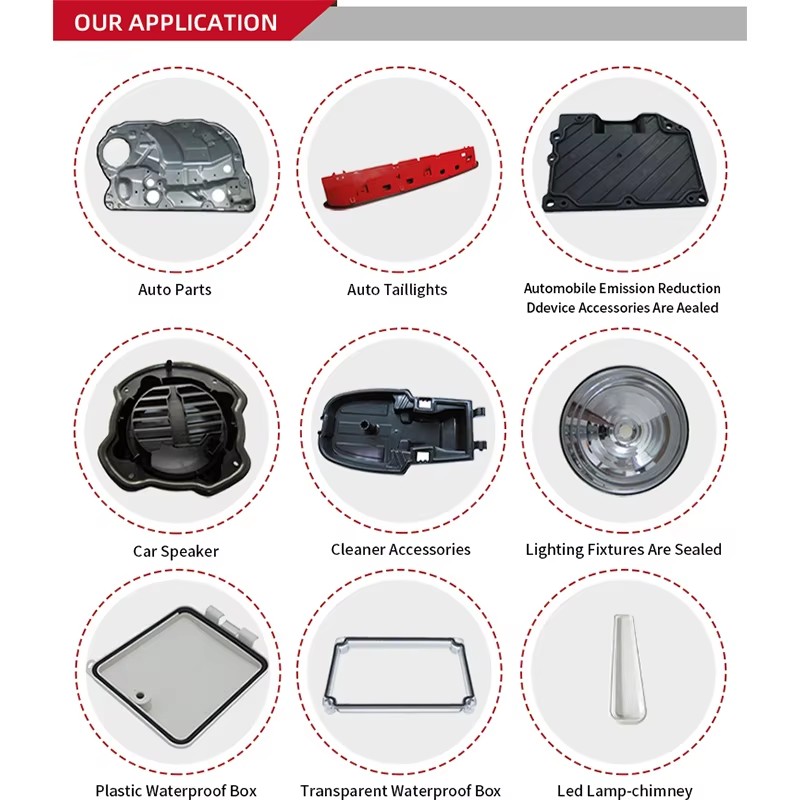
Electrical control panels and distribution boards. This is the core scenario for the comparison. The requirement set combines dust-proof sealing and explosion-proof sealing for enclosures, an IP66 waterproof special requirement, a working condition of −20 to 40 degrees Celsius, and 24/7 continuous operation on an automatic production line matched to an automatic gluing production line. In this combination, manual sealing has to be verified part by part, while a dispensing machine applies the same programmed gasket path to every unit.
Explosion-proof cabinets and sealed enclosures. Here the constraint is documentation as much as geometry. The KW-526's ATEX certification (ECM 25 ATEX-B D001) and the CCC certificate covering explosion-proof enclosure Model BXK-D1 give buyers a machine-and-enclosure compliance chain rather than a process promise.
Automotive and industrial component sealing. For an automotive OEM client in the United States, a paint shop deployment of 20 units has been running for two years, with results reported as stable operation, IP66 waterproof and dust-proof sealing, and high production efficiency. The deployment highlights listed are high precision dispensing, automatic production, and customized gasket shape — the three reasons such a project would be difficult to hold with a manual bench.
Adjacent enclosure-heavy categories. The same equipment is applied across air filters, purification room doors, refrigerator doors, transformer protect covers, waterproof cabinets and boxes, junction boxes, ventilation covers, LED lighting and luminaire housings, street and stadium lighting, lamp covers, and cable connectors. Manufacturers whose product mix spans several of these categories can usually justify automation on the combined volume rather than on a single product line.
Comparison Table: PU Gasket Dispensing Machine vs. Manual Sealing
| Decision factor | Automated PU gasket dispensing (KAIWEI KW series) | Manual sealing |
|---|---|---|
| Gasket formation | Two- or three-component polyurethane applied in place on the part; gasket formed directly on the enclosure | Pre-cut gasket, sealing tape, or hand-applied bead placed on the part |
| Bead dimensional control | Seal strip width configurable from 2–60 mm (KW-526); metering pump A3cc/r and B0.6cc/r; mixing ratio 1–10:1 | Dependent on operator technique; tends to vary between individuals and shifts |
| Production rhythm | Application records specify 24/7 continuous operation and automatic production line operation | Bound to shift patterns, breaks, and manual reloading of the workstation |
| Line integration | Matched equipment is an automatic gluing production line; customization options include automatic feeding for A/B material, elliptical chain worktable, safety grating, and automatic switching workbench | Stand-alone bench; parts are loaded and unloaded by hand |
| Dust-proof / explosion-proof target | Applied to electrical control panels, explosion-proof cabinets, and IP66 waterproof requirements within the −20 to 40 °C working condition record | Achievable at low volume, but verification depends on each individual operator and each individual unit |
| Compliance evidence | Machine and material certificates: ATEX (KW-526, ECM 25 ATEX-B D001), CE (MD-TCF-240307-55472), CCC (2022012304504287), UL94 adhesive, RoHS, VOC CE, ISO 9001:2015 | Process-level records held by the manufacturer; no machine-level certificate for the sealing step itself |
| Pre-shipment quality control | 100% test reported for equipment before shipment | Depends on the factory's own inspection plan and sampling rate |
| Commercial parameters | MOQ 1 SET; lead time 7 days; monthly capacity 2,000 SET; remote after-sales support | No machine lead time; output scales with headcount and training |
Frequently Asked Questions
Which certifications matter when a PU gasket dispensing machine is used for explosion-proof and IP66 enclosure sealing?
Two layers matter: equipment-level and material-level. At equipment level, the CE certification for KAIWEI automatic gluing equipment, certificate MD-TCF-240307-55472 issued by GTS, is based on the 2006/42/EC Machinery Directive and is valid from 2024-04-02 to 2029-04-01. The KW-526 model holds ATEX certification ECM 25 ATEX-B D001 from Ente Certificazione Macchine srl (ECM, Notified Body No. 1282), based on EN IEC 60079-0:2018/A11:2024, EN 60079-1:2014/A11:2024, EN 60079-7:2015/A1:2018, and EN 60079-31:2014, valid from 2025-04-10 to 2030-04-09. A China Compulsory Certificate (2022012304504287, CQC) covers explosion-proof enclosure Model BXK-D1 under the GB/T 3836 series. At material level, the polyurethane sealing foam glue-A carries non-hazardous certification NO.202600234403353 from SICIT under the UN Dangerous Goods Transport Regulations (Maritime), the foaming adhesive is UL94 certified under THSH25033168768EN, RoHS certification UNIB21090613HC-01 references the RoHS Directive (2011/65/EU), VOC CE certification ICR/VC/HS230352 covers the electric enclosure under EN 60529:1991+A2:2013 and EN 62208:2011, and quality management is certified to ISO 9001:2015 by NSY Certification (Shanghai) Co., Ltd.
Can a PU gasket dispensing machine hold sealing quality through 24/7 continuous operation?
The enclosure application records for KAIWEI's PU gasket dispensing equipment specify 24/7 continuous operation and automatic production line operation, matched with an automatic gluing production line, within a working condition of −20 to 40 degrees Celsius. The mechanical basis for that duty rating is visible in the specifications: the KW-526 uses a 6-axis linear robot arm running at 0–12000 mm/min, and the KW-520A uses a 3-axis linear robot arm at the same speed range, both with a metering pump specified at A3cc/r and B0.6cc/r, a mixing ratio of 1–10:1, and high-pressure water cleaning of the mixing head. Seal strip width is configurable from 2–60 mm on the KW-526, or 2–10 mm and 10–60 mm on the KW-523 and KW-523A. In a two-year United States paint shop deployment, an automotive OEM running 20 units reported stable operation, IP66 waterproof and dust-proof sealing, and high production efficiency.
What determines the cost of moving from manual sealing to an automated PU gasket dispensing machine?
Cost is configuration-driven rather than fixed, and KAIWEI publishes no list price, so the honest approach is to budget against the decisions that move the number. First, machine architecture: a 3-axis model such as the KW-523, KW-523A, KW-520A, KW-520B, KW-510B, or 520A-PC versus the 6-axis KW-526; a two-component versus three-component selection; mixing head KW800 or KW-900; metering pump from KAIWEI or Barmag; optional water temperature control; optional filling station; and customized effective stroke and dimension. Second, customization scope: automatic feeding for A/B material, mechanical arm, plasma, logo design, elliptical chain worktable, constant temperature water circulation, safety grating, appearance design, automatic switching workbench, three-component configuration, and support for 12 languages. Third, line integration with an automatic gluing production line. Fourth, commercial terms: MOQ 1 SET, stated lead time of 7 days, monthly capacity of 2,000 SET, and remote after-sales support.
How can an enclosure manufacturer validate the sealing result before committing the whole line?
The minimum order quantity for KAIWEI PU gasket dispensing machines is 1 SET, which allows a single machine to be used for validation on real enclosure parts rather than on samples alone. During validation, the variables worth testing are gasket path on your actual geometry, seal strip width against your groove or flange design, cycle behaviour across a full production shift, and material handling of the polyurethane sealing foam glue-A or foaming adhesive. Every unit is 100% tested before shipment, and customization through the OEM/ODM route allows colour, material, mechanical arm, and language configuration to be set before delivery. Results from a comparable deployment — stable operation, IP66 waterproof and dust-proof sealing, and high production efficiency — give a realistic reference point for what validated performance looks like.
What lead time and support should a buyer expect after placing an order?
KAIWEI states a lead time of 7 days, a monthly capacity of 2,000 SET, and a minimum order quantity of 1 SET, with remote support after delivery. Because the machine sits inside a larger sealing process, the support model matters as much as the delivery date: configuration changes for A/B material feeding, workbench layout, safety grating, and language settings are handled through the customization list rather than as one-off exceptions. Buyers who want to review the full specification set, certification list, and configuration options before ordering can download the KAIWEI product brochure, or send enclosure drawings and sealing requirements directly to the team for a configuration proposal and quotation.
Conclusion: Choose the Method That Matches Your Constraints
Manual sealing remains a legitimate process, and for prototype work, one-off enclosures, and low-volume dust-proof cabinet production it is often the correct one. The comparison changes when the constraint set tightens: explosion-proof or IP66 sealing requirements, a working condition from −20 to 40 degrees Celsius, and a production rhythm that has to hold through 24/7 operation on an automatic gluing production line. At that point, the deciding factors stop being about craft and start being about repeatability, documented compliance, and line-level continuity.
A PU gasket dispensing machine addresses those three factors directly: a metering pump and mixing ratio that define bead geometry instead of leaving it to technique, a 6-axis or 3-axis architecture rated for continuous production, and a certification chain — ATEX on the KW-526, CE, CCC, UL94, RoHS, VOC CE, and ISO 9001:2015 — that travels with the equipment. That is the practical answer to whether automation is necessary: it is necessary when your sealing requirement, your operating environment, and your production rhythm all point at the same time to repeatability that a manual bench cannot document.
Next step: validate on your own enclosure
Send your enclosure drawings, sealing class, and target cycle time to KAIWEI for a configuration proposal covering the KW-526 or a 3-axis model, material selection, and line integration with your automatic gluing production line. Minimum order quantity is 1 SET and the stated lead time is 7 days.
Download the full product and certification brochure: KAIWEI PU Gasket Dispensing Machine Brochure (PDF)
Website: www.sh-kaiwei.com
Email: info@kaiwei-sh.com | Tel / WhatsApp: 13761986986
Address: No.6433 East Yinggang Road, Qingpu District, Shanghai, China
Have Questions or Need More Details?
Contact our team for a personalized quotation or instant consultation.
Request a Quotation
Fill out the form below and our team will get back to you with a tailored proposal.
WhatsApp Direct Chat
Prefer to chat in real-time? Message us on WhatsApp for instant assistance & quick answers.
- Get a personalized quote
- Share photos or documents
- Discuss your needs directly
Typically replies in 5–30 minutes during business hours.