
Long-Term Partnership: PU Gasket Dispensing Machine Acceptance & After-Sales FAQ
Long-Term Partnership: PU Gasket Dispensing Machine Acceptance & After-Sales FAQ
A PU gasket dispensing machine is chosen once and then lived with for years — through gasket redesigns, material batches, audits and line expansions. This FAQ set works through the part of the decision that begins after the purchase order is signed: purchasing terms, acceptance criteria, certification continuity and the after-sales expectations that keep a sealing line producing. Every answer is grounded in the documented facts of the KAIWEI KW-520A platform: CE, ATEX, CCC, UL94, RoHS, VOC CE and ISO 9001:2015 coverage, a non-hazardous PU sealing foam glue-A certificate valid until 31 December 2026, an operating range of −20 °C to 40 °C, and documented applications in electrical control panels, air filters and home appliances.
KAIWEI — Shanghai Kaiwei Intelligent Technology (Group) Co., Ltd. — is a manufacturer of industrial sealing systems and robot foaming equipment, founded in 2004 and headquartered in Shanghai. Its PU gasket dispensing machines are supplied to producers of electrical control panels, air filters and home appliances, and the platform discussed here is the KW-520A.
What does “long-term partnership” actually mean after the machine is installed?
In equipment procurement, a long-term partnership is the supplier's continuing ability to answer three questions after delivery: can this machine keep producing to the specification that was accepted, can its compliance documentation be kept current, and can the buyer obtain technical answers without renegotiating the contract. Everything else — goodwill, familiarity, discount talk — sits on top of those three.
That definition matters because the after-sales conversation is usually conducted in vague terms. KAIWEI does not publish service-level figures such as response times, warranty durations or spare-part availability percentages in the material used for this article, so this FAQ does not quote any. What it does instead is separate the items that are already documented on the KW-520A from the items a buyer should fix in writing at acceptance. That separation is the practical difference between a supplier relationship and an ownership plan.
Four pillars carry the relationship:
- Acceptance evidence — a signed inspection record, agreed test scope and a document pack, so that “as specified” is a fact rather than a memory.
- Compliance continuity — certificates with issue and expiry dates tracked by the buyer, not filed once and forgotten.
- Application continuity — the machine stays matched to the parts it seals as panel sizes, filter geometries or appliance models change.
- Communication continuity — a named technical route for process questions, consumables and spares after the sales cycle ends.
Why acceptance and certification records decide the next five years
Formed-in-place polyurethane gasket dispensing is a wet-chemistry process. A two-component foaming machine meters, mixes and deposits reactive material, so the gasket's final geometry and adhesion depend on material grade, mix consistency, ambient conditions and dispense parameters working together. That is why the documentation attached to a PU foam sealing machine is not a filing formality: it defines the conditions under which the accepted result can be reproduced.
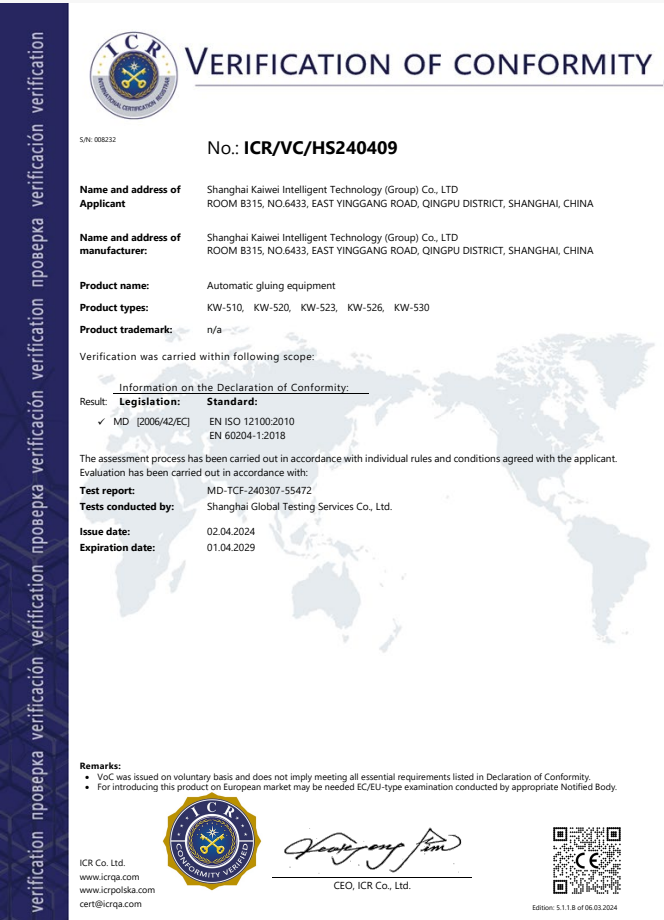
Certificate sets are frequently misread during procurement because they cover different legal objects. CE addresses machine safety for European market placement; ATEX addresses equipment intended for explosive atmospheres; CCC addresses Chinese market access; UL94 is a flammability classification of the material; RoHS restricts substances in electrical and electronic equipment; VOC CE addresses emissions-related conformity for the sealing material; and ISO 9001:2015 covers the quality management system rather than any single product's performance. A buyer who treats this list as one interchangeable block of “certifications” will eventually discover that a machine certificate does not certify a gasket material — and that an expired material certificate can hold up a finished-goods compliance file long after the machine was accepted.
For context on the scale of the category, commercial research placed the broader polyurethane processing machinery market at USD 4.07 billion in 2025. That figure covers PU processing equipment generally and does not size the PU gasket dispensing segment, so it is useful only as background for why documentation practices in this equipment class have become more formal, not as a benchmark for any individual purchase.
KW-520A: the documented facts a partnership FAQ can rely on
The KW-520A is the reference platform for this discussion. The table below lists only what is documented; where a specification is not stated, it is not implied.
| Item | Documented position |
|---|---|
| Machine certification coverage | CE, ATEX, CCC |
| Material and emissions documentation | UL94, RoHS, VOC CE |
| Quality management coverage | ISO 9001:2015 |
| Sealing material | Non-hazardous PU sealing foam glue-A; certificate valid until 31 December 2026 |
| Operating temperature range | −20 °C to 40 °C |
| Documented applications | Electrical control panels, air filters, home appliances |
| Manufacturer production capacity | 2,000 sets per month (company-reported) |
Two of these rows deserve emphasis at the acceptance stage rather than the quotation stage. The first is the operating range. A range of −20 °C to 40 °C is a statement about where the equipment is expected to operate, and a workshop that exceeds 40 °C in summer, or a facility that drops below −20 °C during winter shutdowns, has a commissioning issue to solve before the gasket specification can be discussed at all. The second is the glue-A certificate's expiry date, which is a calendar item rather than a machine feature and is treated separately below.
Purchasing terms and acceptance criteria, explained
KAIWEI's stated purchasing terms for this equipment class are: minimum order quantity of 1 unit; delivery terms FOB or CIF; payment terms 30/70; and acceptance criteria based on full inspection before shipment, with third-party testing available for the acceptance procedure. Those five items are the commercial spine of the relationship, and each one changes something specific for the buyer.
| Term | What it means in practice |
|---|---|
| MOQ: 1 unit | A single machine can be ordered and accepted on its own, which allows a line to be validated before further units are committed. |
| Delivery terms: FOB / CIF | The Incoterm chosen determines who controls freight, insurance and routing. With CIF the seller arranges carriage and insurance to the named destination port; with FOB the buyer takes over the main carriage. The choice affects when the buyer can schedule receiving inspection. |
| Payment terms: 30/70 | A 30% advance and 70% balance structure places the balance payment after the pre-shipment milestone. That is the point at which the inspection report should already exist. |
| Acceptance: full inspection before shipment | Inspection happens at the factory, before the machine is packed. Agree the item list, the report format and who signs it — not just the principle. |
| Acceptance: third-party testing available | An independent test can be arranged for the acceptance procedure. Decide the scope, the laboratory, the cost responsibility and whether the test is a pre-shipment condition. |
The single most common omission is not the payment split but the inspection scope. “Full inspection before shipment” answers when the inspection happens; it does not by itself define what is checked. A useful acceptance annex for a PU gasket dispensing machine names the gasket geometry and bead dimensions to be demonstrated, the substrate used, the material batch, the ambient temperature at test, the dispense programme, and the visual and dimensional acceptance limits. Without that annex, the acceptance meeting becomes a demonstration, and a demonstration cannot be repeated in a dispute.
Step-by-step: running the acceptance properly
Step 1 — Anchor the configuration to one real part
Acceptance should be tied to a specific production part from your plant, not a generic sample: a control panel door, an air filter frame or an appliance housing. The KW-520A's documented applications are electrical control panels, air filters and home appliances, so name which of those the machine is being accepted against and which part number represents it.
Step 2 — Convert “full inspection” into a written protocol
Ask for the inspection item list before the machine is built. At minimum the protocol should record the dispense programme used, the observed gasket bead, the material batch and the machine's condition at the recorded ambient temperature inside the −20 °C to 40 °C operating range.
Step 3 — Decide on third-party testing before the balance payment date
Third-party testing is available for acceptance, so the decision has to be made early enough to schedule it. Agree who selects the laboratory, what is measured, and whether the result is a release condition or a reference record.
Step 4 — Collect the document pack at shipment, not later
The pack should contain the CE, ATEX and CCC machine documentation, the UL94, RoHS and VOC CE material documentation, the ISO 9001:2015 quality system evidence, and the non-hazardous PU sealing foam glue-A certificate showing validity to 31 December 2026. Record each document's identifier and date on the acceptance sheet.
Step 5 — Verify the installation environment against the operating range
Confirm the planned cell stays within −20 °C to 40 °C across the year, including seasonal peaks and night-time lows, and document the measured values. Environmental verification is cheap before installation and expensive afterwards.
Step 6 — Record a production baseline
Record the accepted parameters, gasket appearance, cycle pattern and material batch as a baseline file. This baseline is what makes a future troubleshooting conversation possible without re-testing everything.
Step 7 — Set the annual compliance review date
Put the certificate dates — especially the glue-A validity date — into the maintenance calendar alongside the machine's own service schedule, so compliance review does not depend on someone remembering a filing cabinet.
Certification continuity: the dates to keep on a calendar
Certification continuity is where long-term partnerships are usually won or lost quietly. Below is how each document in the KW-520A set should be handled after acceptance.
| Document | What it covers | Post-acceptance handling |
|---|---|---|
| CE | Machine conformity for European market placement | Keep the declaration and technical documentation on file; re-check if the machine is modified or relocated. |
| ATEX | Equipment for explosive atmospheres | Confirm the documented rating still matches the area classification of the cell it serves, and re-verify after any modification. |
| CCC | Chinese market access | Relevant where the machine is installed or the finished product is placed on the Chinese market; keep with the asset file. |
| UL94 | Flammability classification of the gasket material | Feed into end-product safety files, particularly for electrical control panels; keep the material grade traceable to the certificate. |
| RoHS | Restricted substances in electrical and electronic equipment | Retain for EU-bound finished goods; update if the material supplier changes. |
| VOC CE | Emissions-related conformity for the sealing material | Relevant for appliance and indoor applications; hold with the material documentation rather than the machine file. |
| ISO 9001:2015 | Quality management system coverage | Evidence of process discipline, not a product performance certificate — treat it accordingly in supplier reviews. |
| PU sealing foam glue-A (non-hazardous) | Material classification of the sealing foam | Valid until 31 December 2026. Record the validity date now and confirm current status with the supplier before that date. |
Use cases: what each documented application demands after acceptance
The three documented applications for the KW-520A place different demands on the long-term relationship, which is why the acceptance annex should be application-specific.
Electrical control panels
Panel gaskets are functional seals: the bead must close consistently around doors and cut-outs, and the finished assembly often carries its own safety and compliance file. For this application the buyer's post-acceptance priority is document traceability — keeping UL94 and RoHS material evidence tied to the batch actually dispensed — plus a baseline that allows a bead change to be detected early.
Air filters
Filter frame sealing is volume-driven and geometry-driven. Here the acceptance emphasis sits on repeatability across a run rather than on a single sample, and the long-term priority is that the recorded dispense programme stays valid when filter sizes or frame materials change.
Home appliances
Appliance gaskets combine appearance, sealing and emissions considerations. VOC CE and material documentation belong in the end-product file, and the operating range check matters because appliance plants frequently run warmer than machine halls.
How production continuity is protected during ownership
Continuity has two halves: the machine's own protective design and the manufacturer's ability to keep supplying. On the machine side, KAIWEI documents an independent intelligent temperature control module with real-time temperature monitoring and over-temperature alarms, high-precision servo dispensing valves with pressure feedback, automatic glue-leakage detection with shutdown protection, automatic glue-quantity calibration, insulation protection, emergency stop, and an IP65/IP66 enclosure design. In a polyurethane foaming machine these functions matter because the two failure modes that stop a line — overheating during continuous operation and glue overflow onto product — are exactly what they are designed to intercept.
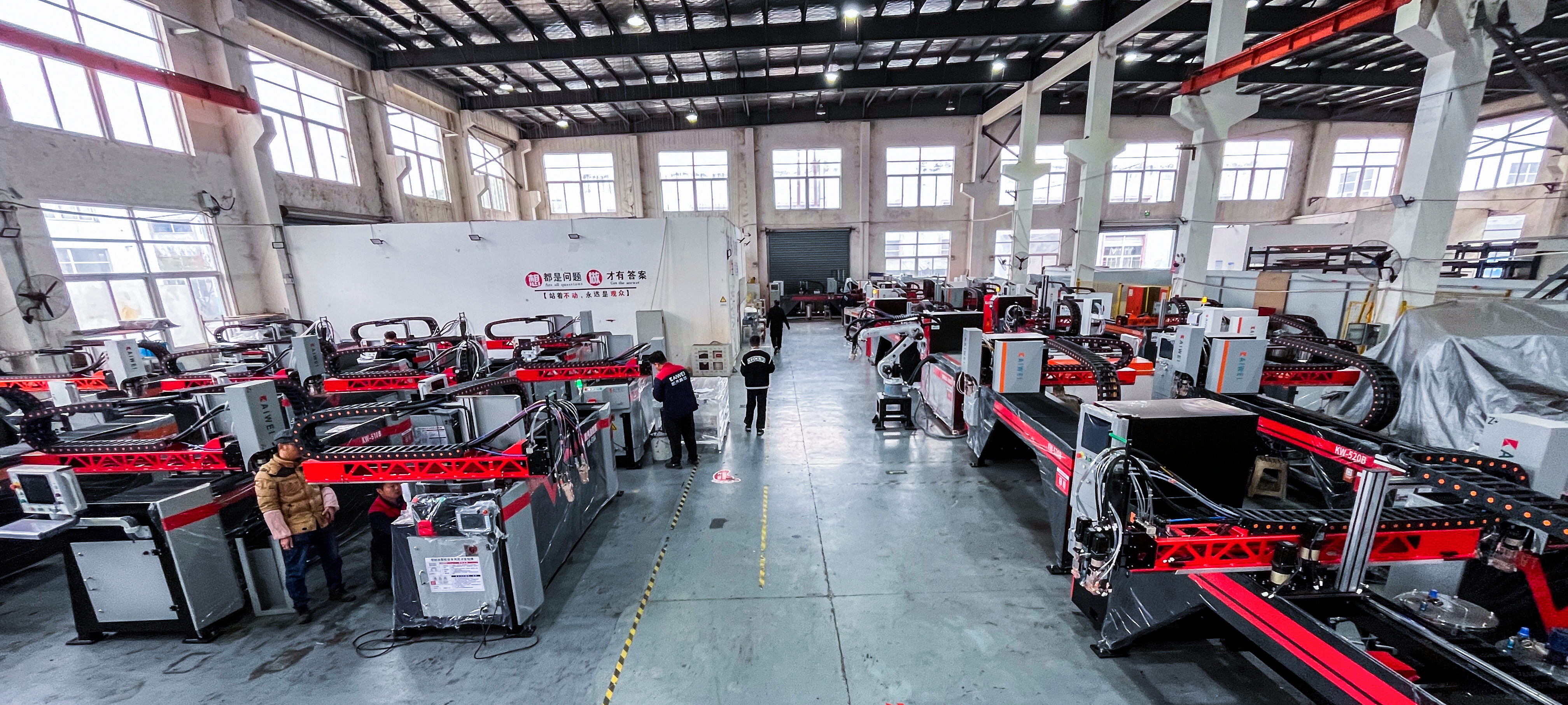
On the supply side, the manufacturer reports a monthly production capacity of 2,000 sets, supported by a facility of more than 20,000 m², a workforce of over 100 and an engineering team of more than 30. For a buyer planning a multi-year rolling programme, a documented capacity figure is more useful than a promise, because it can be compared against forecast demand and revisited when volumes change.
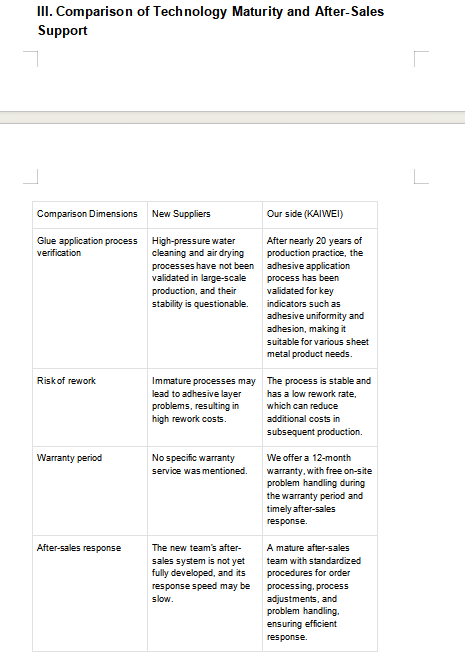
KAIWEI's own comparison material reports 20% higher production efficiency, 30% higher mixing uniformity, 15% lower total cost of ownership and less maintenance relative to other domestic dispensing machines. These are manufacturer-reported comparisons rather than independently validated measurements, so the practical use of those figures is as a list of claims to verify during acceptance testing — measured efficiency, measured material consumption, observed maintenance intervals — rather than as settled outcomes.
| Item | Status to confirm |
|---|---|
| Pre-shipment inspection report | Item list agreed, signed, dated, matched to the accepted part number |
| Third-party test record (if elected) | Scope, laboratory, result and release decision documented |
| Machine certificates (CE, ATEX, CCC) | Identifiers and dates copied into the asset file |
| Material documents (UL94, RoHS, VOC CE) | Matched to the material grade actually supplied |
| Quality system evidence (ISO 9001:2015) | Retained for supplier reviews, distinguished from product certificates |
| Glue-A certificate | Validity noted: until 31 December 2026; status re-confirmed before that date |
| Operating envelope record | Measured cell temperature documented against −20 °C to 40 °C |
| Production baseline | Parameters, bead record, material batch and ambient conditions filed |
Frequently asked questions
Which certificates arrive with a KW-520A, and what does each one actually cover?
The KW-520A documentation set covers CE, ATEX and CCC for the machine, UL94, RoHS and VOC CE for the material and emissions side, and ISO 9001:2015 for the quality management system; the non-hazardous PU sealing foam glue-A certificate is valid until 31 December 2026. These cover different objects and should not be filed as one block. A machine safety certificate does not certify a gasket material's flammability or emissions, and a quality system certificate is not a statement about any individual machine's performance. The practical answer is to copy each document's identifier and date onto the acceptance sheet so the coverage boundary is visible later.
What are KAIWEI's purchasing terms and acceptance criteria?
Documented terms are: minimum order quantity 1 unit; delivery terms FOB or CIF; payment terms 30/70; acceptance criteria based on full inspection before shipment, with third-party testing available for the acceptance procedure. The buyer's work is to convert these into a written annex — which inspection items, which report format, which laboratory if third-party testing is elected, and whether the test result is a release condition. Fixing that scope before the machine is built is what makes the 30/70 structure work in the buyer's favour, because the balance milestone then coincides with a documented result rather than a demonstration.
The glue-A certificate expires on 31 December 2026 — what should a buyer do before then?
Record the certificate version supplied with your machine and its validity date, then ask the supplier to confirm the current status of the non-hazardous PU sealing foam glue-A documentation before 31 December 2026. Where the gasket feeds a finished product with its own compliance file, the material document should be updated in that file at the same time. Until the supplier confirms otherwise, the acceptance file should state only what is documented — that the certificate is valid to that date — rather than assume a renewal. This is a routine calendar task if it is captured at acceptance and a disruptive one if it is discovered during an audit.
What protects output consistency during long, continuous production runs?
Consistency rests on documented machine functions plus a controlled environment. The KW-520A design includes an intelligent temperature control module with real-time monitoring and over-temperature alarm, high-precision servo dispensing valves with pressure feedback, automatic glue-leakage detection with shutdown protection, automatic glue-quantity calibration and an IP65/IP66 enclosure design. The environment is equally part of the specification: the documented operating range is −20 °C to 40 °C, so a cell that drifts outside it has left the accepted conditions. Recording ambient temperature alongside the production baseline turns this from an assumption into a measurable check.
Which applications is this platform documented for, and what should be verified in each?
Electrical control panels, air filters and home appliances are the documented applications. For control panels, verify bead continuity around doors and cut-outs and keep UL94 and RoHS material evidence aligned with the batch dispensed. For air filters, verify repeatability across a full run rather than a single sample, since filter sealing is volume and geometry driven. For home appliances, verify that VOC CE and material documentation enter the end-product file, and confirm the plant temperature stays inside the −20 °C to 40 °C operating range.
What should be budgeted over the ownership period?
No price list is quoted here, because configuration, Incoterm and testing scope change the figure and no verified pricing was available for this article. What can be planned is the cost structure: sealing material and consumables at the consumption rate measured during acceptance; spare parts identified at acceptance against the machine's documented assemblies; the compliance review workload around certificate validity dates; training and documentation for operators; and the freight and insurance consequence of choosing FOB rather than CIF. Building those five lines into the business case at procurement stage is more reliable than comparing headline machine prices across configurations that are not identical.
How does a long-term supply and support agreement get started?
Start with three documents rather than a negotiation: the production part or part family the machine must seal, the acceptance annex including any third-party testing scope, and the document pack list you need at handover. Send those with your volume outlook and preferred Incoterm, and ask for a quotation that separates machine configuration, delivery term and acceptance testing. That request produces comparable offers and makes the after-sales conversation concrete from the first exchange. KAIWEI's monthly production capacity of 2,000 sets is company-reported and can be discussed against your own forecast; delivery schedules should always be confirmed per order and configuration.
Conclusion: partnership is a documentation habit
The KW-520A gives a buyer a specific and checkable starting point: CE, ATEX, CCC, UL94, RoHS, VOC CE and ISO 9001:2015 coverage, a non-hazardous PU sealing foam glue-A certificate valid until 31 December 2026, an operating range of −20 °C to 40 °C, documented applications in electrical control panels, air filters and home appliances, and stated purchasing terms built on a 1-unit minimum, FOB or CIF delivery, 30/70 payment, full pre-shipment inspection and optional third-party testing. None of that replaces an acceptance annex, and none of it renews itself.
What makes a PU gasket dispensing machine a long-term asset rather than a purchase is the habit built around it: a written inspection protocol, a dated certificate register, a measured operating envelope and a production baseline that survives staff changes. Buyers who insist on those four items at acceptance spend far less of the following five years reconstructing what was agreed.
Plan your acceptance before the machine ships
KAIWEI supplies PU gasket dispensing machines to electrical panel, air filter and home appliance producers, with documented certification coverage and stated acceptance terms. To move from evaluation to execution, request the current technical documentation, the certificate set with validity dates, and an acceptance and delivery proposal for your specific part.
Contact: Wendy — info@kaiwei-sh.com · Tel / WhatsApp: 13761986986 · Address: No.6433 East Yinggang Road, Qingpu District, Shanghai, China.
Download the company and product brochure for the full specification and application overview: KAIWEI brochure (PDF).

Have Questions or Need More Details?
Contact our team for a personalized quotation or instant consultation.
Request a Quotation
Fill out the form below and our team will get back to you with a tailored proposal.
WhatsApp Direct Chat
Prefer to chat in real-time? Message us on WhatsApp for instant assistance & quick answers.
- Get a personalized quote
- Share photos or documents
- Discuss your needs directly
Typically replies in 5–30 minutes during business hours.