How a PU Gasket Dispensing Machine Works: Technical Overview
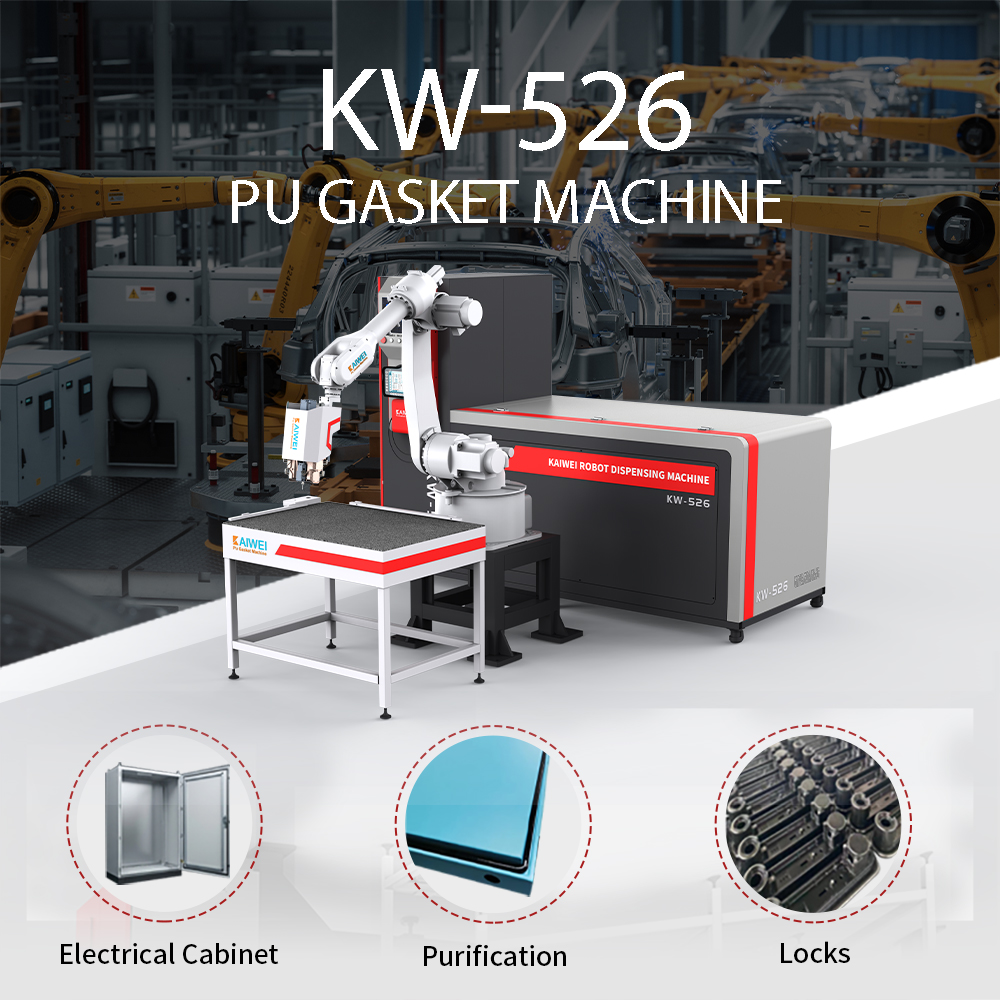
A PU gasket dispensing machine is an automated gasket making machine that meters, mixes, and dispenses two-component polyurethane foam onto a part surface, where the foam expands and cures to form a sealing gasket in place. It is also described as a polyurethane foaming machine, a PU foaming machine, an automatic foam gasket machine, a foam gasket sealing machine, or an FIPFG (form-in-place foam gasket) machine. Unlike a pre-cut rubber gasket, the foam seal is created directly on the component along the exact sealing channel.
Shanghai Kaiwei Intelligent Technology (Group) Co.,LTD (KAIWEI) is a Shanghai-based, state-level high-tech enterprise founded in 2004 that specializes in the R&D and manufacturing of industrial sealing systems, robot foaming equipment, intelligent sealing and dispensing equipment, and six-axis robotic foaming systems. KAIWEI products are exported to more than 60 countries including Germany, the United States, and Southeast Asia, and the company's automatic adhesive and dispensing equipment is used in electric cabinets, air filters, air conditioning purification equipment, lamps, automobiles, and new energy fields. This article explains how a PU gasket dispensing machine works, the components of a typical system, and what to check when evaluating a machine for industrial sealing automation.
Why Automated Foam Gaskets Replace Manual Sealing
Electrical control panels, distribution boards, junction boxes, filter housings, and lighting enclosures require a seal that keeps out dust and water; in hazardous-area products, the enclosure seal also supports explosion-proof protection. Manual gasketing with pre-cut rubber or foam tape creates several problems: gaskets must be stocked in many sizes, placed by hand, and aligned perfectly; corners and joints are common leak points; and the gasket can shift during assembly. In continuous production, manual application is difficult to perform 24/7 at consistent quality.
A PU gasket dispensing machine addresses these problems by applying the gasket directly as liquid foam. The seal follows the exact contour of the part, corners are continuous, and the same machine can run different part sizes by switching the programmed path. In these automatic sealing projects, the machine operates in a 24/7 continuous operation mode on an automatic production line.
Market Context for PU Gasket Dispensing Machines
Industry analysis values the global market for PU gasket dispensing machines at approximately USD 1.2 billion in 2025. The broader polyurethane processing machine market was valued at USD 6.627 billion in 2024 and is projected to grow at a CAGR of 10.21% through 2035, according to Market Research Future. Form-in-place (FIP) liquid gaskets reached USD 270 million in 2023, with increasing adoption in EV battery enclosures. Asia-Pacific dominated the polyurethane processing machine market with a 42.2% share, driven by industrial manufacturing growth in China, and high-pressure PU processing units accounted for 68% of the global machine-type market share.
Recognized global suppliers in the FIPFG and PU dispensing equipment sector include Sonderhoff (a Henkel brand), RAMPF Group, and Cera-Tec; KAIWEI is also listed among the sector's suppliers. For procurement teams, the category now spans European equipment specialists and China-based manufacturers, and the practical consequence is that specification and price levels differ accordingly.
Inside a PU Gasket Dispensing Machine: Core Subsystems
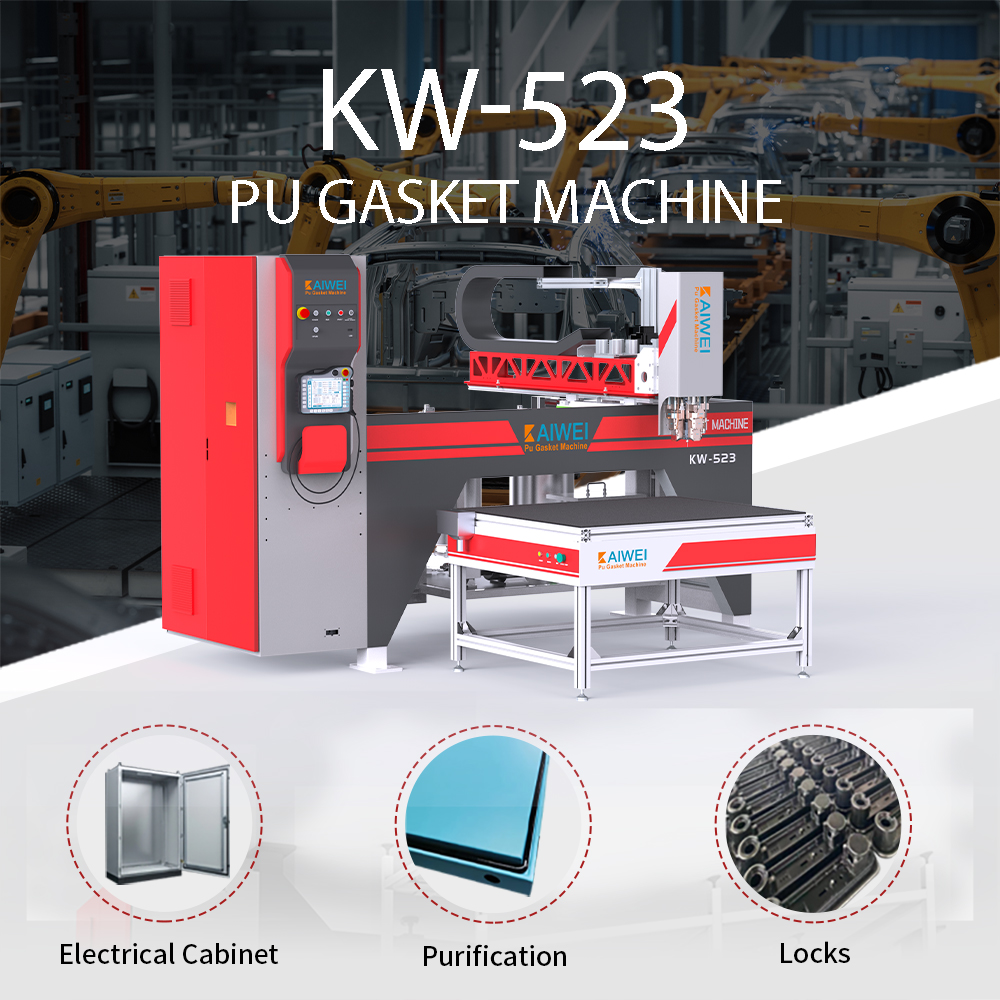
KAIWEI's KW-series PU gasket dispensing machines are two-component foaming systems, sometimes called a polyurethane glue dispenser or an automatic foaming machine in trade literature. Each machine is built from six subsystems:
- Raw material supply. Two 40-liter air-pressure tanks hold the two liquid components (tank A and tank B). Tank A is equipped with agitation; tank B is not. Tank filling is manual or automatic, and an optional filling station is available.
- Metering. Metering pumps from KAIWEI or Barmag feed the components at a ratio adjustable from 1:1 to 10:1, with a pump specification of A 3cc/rev and B 0.6cc/rev.
- Mixing and dispensing. The components are mixed in a KW800 or KW-900 mixing head immediately before dispensing. Seal strip width ranges from 2–60mm depending on the model. High-pressure water cleans the mixing head, preventing cured polyurethane from blocking the nozzle.
- Motion system. The dispensing path is executed by a 3-axis linear robot arm on most models, or a 6-axis linear robot arm on the KW-526, at running speeds up to 12,000mm/min. Guide rails are AIRTAC or KAIWEI/AIRTAC, and servo motors are sourced from Xinje, ABB, Fuji, Panasonic, Nidec, STEP, or Leadshine.
- Control system. Operation runs through a 10.2-inch, 12.1-inch, or 15-inch touch-screen HMI with PC or teach pendant operation, and a motion control card or teach pendant + PLC controller. The interface is an integrated operation box on most models; the 520A-PC uses teach pendant control and the KW-510B uses a cantilever control box.
- Frame and utilities. The workbench uses square-tube welding and is built from carbon steel, stainless steel 304, or aluminum alloy. Power is 220V/380V at 4kW or 5.5kW, compressed air must be ≥6bar with oil-water separator treatment, and the water tank includes a front level sensor and outlet filtration.
The PU Gasket Dispensing Process Step by Step
The operating sequence of a KAIWEI automatic foam gasket machine follows a repeatable cycle:
- Programming. The operator defines the gasket path on the touch-screen HMI using PC or teach pendant operation. The motion control card and PLC store the program for repeat runs.
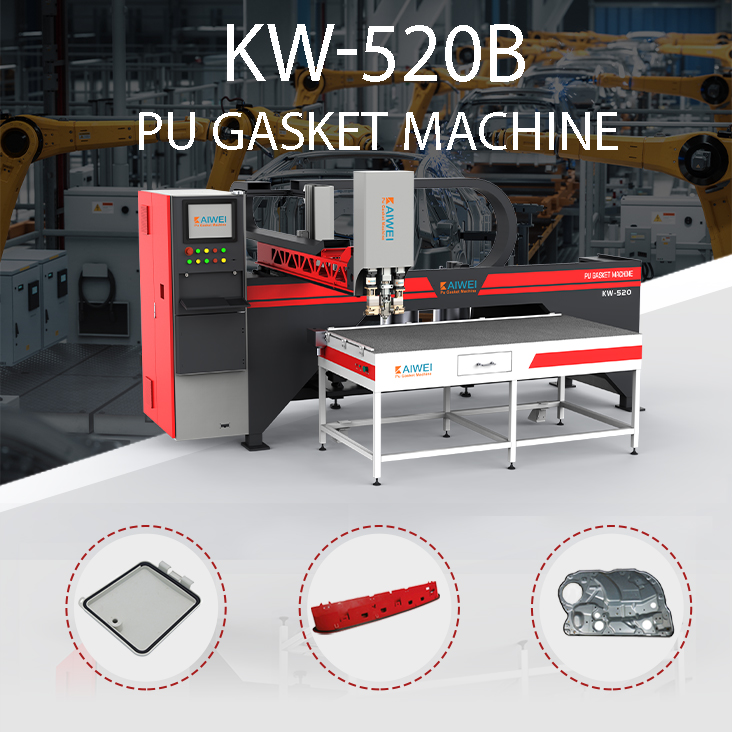
- Part loading. The workpiece is placed on the square-tube-welded workbench. Effective strokes are 1250×800×200mm (KW-523, KW-523A), 2250×1250×200mm (KW-510B, KW-520A, KW-520B, 520A-PC), or customized (KW-526). The overall machine dimension is 2000×1000×800mm on most models.
- Material conditioning. Two-component polyurethane is held in the 40L air-pressure tanks. Optional water temperature control stabilizes viscosity, and tank A agitation keeps the filled component homogeneous. Tank filling can be manual or automatic.
- Metering. The metering pump set draws the components and feeds the mixing head at the programmed ratio (1–10:1).
- Dispensing. The KW800 or KW-900 mixing head mixes the components and dispenses the foaming mixture along the programmed path, forming a continuous seal strip from 2mm up to 60mm wide depending on the model.
- Cleaning. After dispensing, the mixing head is flushed with high-pressure water to remove uncured material.
- Curing and unloading. The applied foam cures on the part into the finished foam gasket, and the operator unloads the part and loads the next one.
- Line integration. The PU gasket dispensing machine is designed for 24/7 continuous operation and automatic production line operation, and it can be configured with an automatic gluing production line.
KAIWEI KW-Series Model Comparison
KAIWEI offers seven PU gasket dispensing machine models. The main differences are the axis configuration, effective stroke, seal strip width range, and control interface:
| Model | Frame Structure | Seal Strip Width | Effective Stroke (mm) | HMI | Mixing Head |
|---|---|---|---|---|---|
| KW-510B | 3-axis linear robot arm | 4–30mm | 2250×1250×200 | 12.1" touch screen | KW-900 |
| KW-520A | 3-axis linear robot arm | 4–30mm | 2250×1250×200 | 10.2" touch screen | KW800 |
| 520A-PC | 3-axis linear robot arm | 4–30mm | 2250×1250×200 | 10.2" touch screen | KW800 |
| KW-520B | 3-axis linear robot arm | 4–30mm | 2250×1250×200 | 15" touch screen | KW-900 |
| KW-523 | 3-axis linear robot arm | 2–10mm / 10–60mm | 1250×800×200 | 15" touch screen | KW800 / KW-900 |
| KW-523A | 3-axis linear robot arm | 2–10mm / 10–60mm | 1250×800×200 | 15" touch screen | KW800 / KW-900 |
| KW-526 | 6-axis linear robot arm | 2–60mm | Customized | 15" touch screen | KW800 / KW-900 |
All KW-series models process polyurethane; the KW-523 and KW-523A also support silicone. All accept two-component or three-component material selection, run on 220V/380V at 4kW/5.5kW, and require an air supply of at least 6bar. Raw material tank volume is 40L per component on every model.
3-Axis for Panels, 6-Axis for Complex Contours
For flat or gently contoured enclosure lids and panels, a 3-axis linear robot arm (KW-510B, KW-520A, 520A-PC, KW-520B, KW-523, KW-523A) is the standard choice. For parts that need gaskets on inclined or multi-planar surfaces, the 6-axis KW-526 provides additional positioning freedom and a customized effective stroke. An honest limitation of any PU gasket dispensing machine is that the part must present a continuous, programmable sealing channel; parts with complex 3D geometry should be reviewed against the mixing head reach and the selected axis count before purchase.
Applications and Target Industries
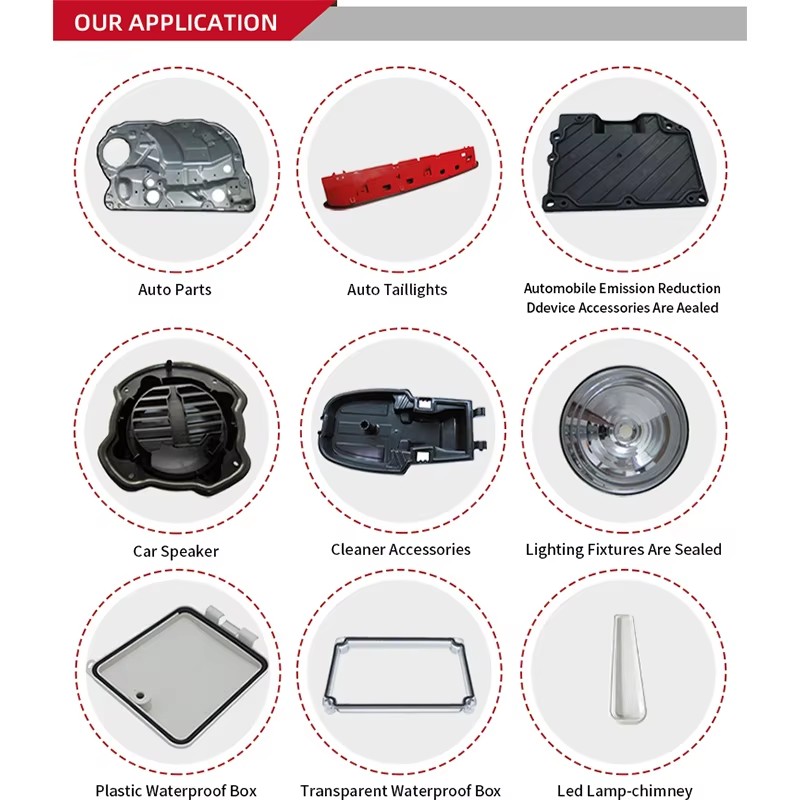
KAIWEI PU gasket dispensing machines are used in automatic sealing projects across several industries:
- Electrical control panels and electrical distribution boards
- Explosion-proof electrical and special electrical equipment
- Purification, environmental protection and filtration equipment
- Home appliances
- Auto parts and components
- Lighting and LED lighting
- Lock and hardware accessories
The typical function is dust-proof sealing and explosion-proof sealing for enclosures. The machines are designed to operate within an ambient temperature range of −20°C to 40°C and support 24/7 continuous operation. For electrical control panel applications, the special requirements include explosion-proof and IP66 waterproof specifications, and the machine is integrated into an automatic gluing production line. These application scenarios are common in the United States, China, India, Germany, Japan, Italy, and Russia, as well as across Asia, Europe, Africa, and the Americas.
Manufacturing and Quality Background

Shanghai Kaiwei Intelligent Technology (Group) Co.,LTD was established in 2004 and operates a 20,000m²+ manufacturing facility with more than 100 employees and an annual output of about 2,000 units. The R&D team includes 30+ engineers and professionals, and the company holds more than 100 national patents, including innovations related to robot quantitative foaming machines. Its automatic adhesive and dispensing equipment has passed international certifications including CE and ISO9001. Export business accounts for approximately 70% of total sales, with major markets in Asia, Europe, the Americas, and Africa. Main products include PU foam gasket machines, adhesive PU, sealing foam glue, explosion-proof cabinets, and UV flatbed printers.
FAQ
What certifications apply to PU gasket dispensing machines?
PU foaming machines sold in the European Union must comply with the EU Machinery Directive 2006/42/EC and EN 60204-1 for electrical safety to obtain CE marking. KAIWEI's automatic adhesive and dispensing equipment has passed international certifications including CE and ISO9001. In enclosure-sealing applications that require explosion-proof and IP66 waterproof performance, the dispensing equipment is applied under those special requirements in automatic sealing projects.
What materials and gasket sizes can a PU gasket dispensing machine process?
KAIWEI KW-series machines process polyurethane; the KW-523 and KW-523A also process silicone. They support two-component or three-component material selection with a mixing ratio adjustable from 1:1 to 10:1. Seal strip width ranges from 2–60mm on the KW-526, 4–30mm on the KW-510B, KW-520A, 520A-PC, and KW-520B, and 2–10mm or 10–60mm on the KW-523 and KW-523A. Raw material is supplied from two 40L air-pressure tanks, and metering pumps are KAIWEI or Barmag units (A 3cc/rev, B 0.6cc/rev).
What determines the budget for a PU gasket dispensing machine?
Budget depends on the configuration selected: frame structure (3-axis vs 6-axis linear robot arm), effective stroke (1250×800×200mm, 2250×1250×200mm, or customized), mixing head (KW800 vs KW-900), metering pump brand (KAIWEI vs Barmag), touch screen size (10.2 to 15 inches), and optional systems such as water temperature control, automatic tank filling, and a filling station. Because each machine is configured per application, the practical way to define a budget is to send part drawings with the required production rate and request a formal quotation.
Can I validate the machine with my parts before purchasing?
Sample validation is the standard way to confirm that a PU gasket dispensing machine produces the correct gasket cross-section on the actual production material. KAIWEI's engineering team of 30+ engineers can review the part drawings and application requirements, then recommend the appropriate model based on the required seal strip width, stroke, and cycle time. The practical next step is to send drawings of the enclosure, the sealing specification (dust-proof, waterproof, explosion-proof, IP66), and the target output rate to KAIWEI for a recommendation.
What is the delivery lead time for a PU gasket dispensing machine?
Lead time depends on the model and the degree of customization, including the stroke, pump selection, and optional systems. KAIWEI's Shanghai facility has an annual production capacity of approximately 2,000 units, and the current lead time for a specific configuration is confirmed against the production schedule. To request a quotation, sample validation, or the latest delivery schedule, contact KAIWEI by email at info@kaiwei-sh.com or WhatsApp at +86 137 6198 6986.
Conclusion
A PU gasket dispensing machine converts two-component polyurethane into a formed-in-place foam gasket directly on the part, replacing manual gasket installation with a programmable, repeatable sealing process. KAIWEI's KW series covers 3-axis panel sealing and 6-axis custom-contour applications, with seal strip widths from 2–60mm, mixing ratios from 1:1 to 10:1, and CE- and ISO9001-certified manufacturing in Shanghai. The right model is determined by part geometry, seal specification, and production volume — the three inputs for a machine configuration and quotation.
Talk to KAIWEI about your gasket sealing project.
Company: Shanghai Kaiwei Intelligent Technology (Group) Co.,LTD | Website: kaiweicn.com
Email: info@kaiwei-sh.com | Tel / WhatsApp: +86 137 6198 6986
Address: No.6433 East Yinggang Road, Qingpu District, Shanghai, China
Have Questions or Need More Details?
Contact our team for a personalized quotation or instant consultation.
Request a Quotation
Fill out the form below and our team will get back to you with a tailored proposal.
WhatsApp Direct Chat
Prefer to chat in real-time? Message us on WhatsApp for instant assistance & quick answers.
- Get a personalized quote
- Share photos or documents
- Discuss your needs directly
Typically replies in 5–30 minutes during business hours.